
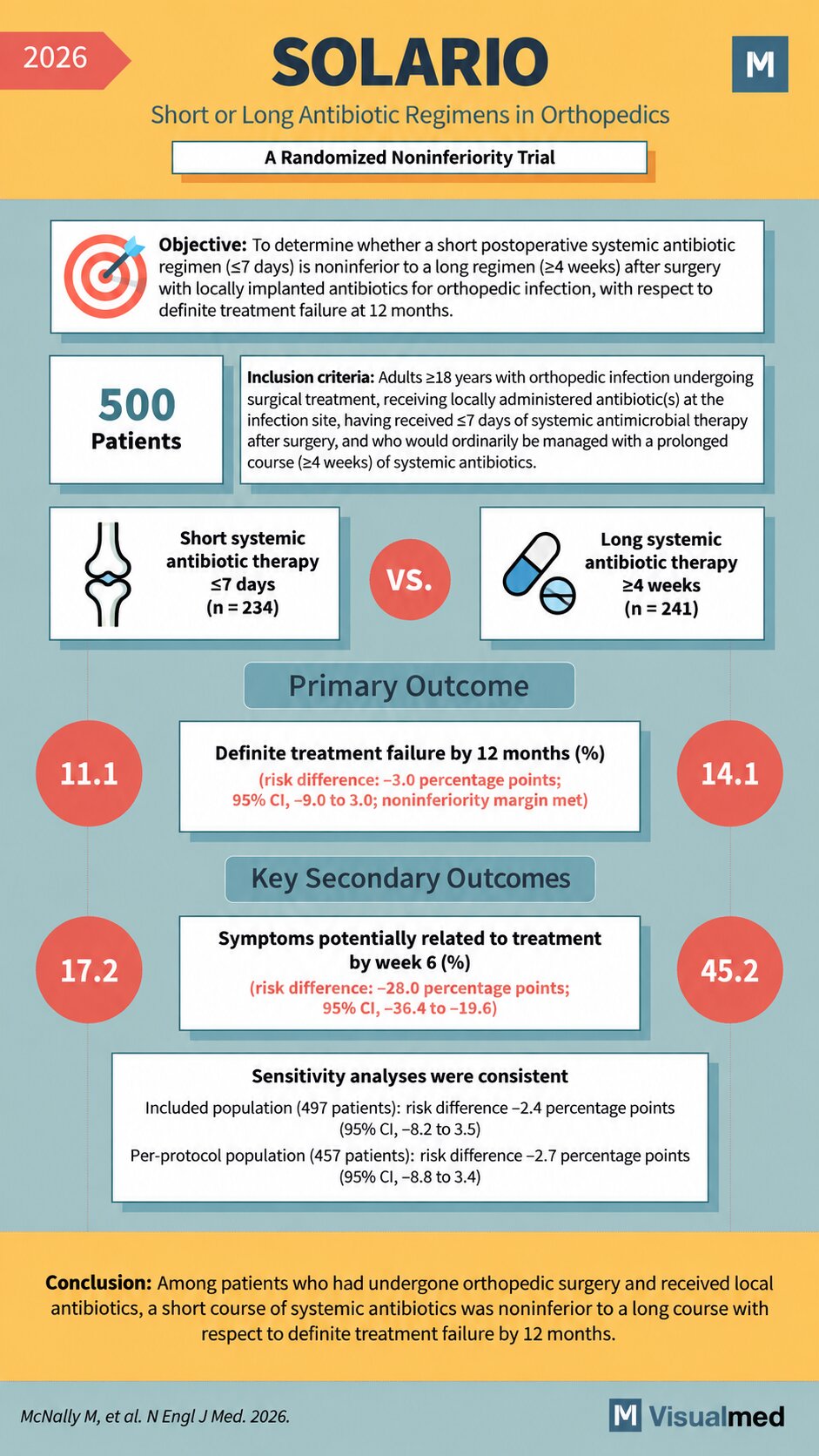
The SOLARIO trial, published in the New England Journal of Medicine in 2026, challenges the traditional practice of prolonged systemic antibiotic therapy after surgery for orthopedic infection.
In this randomized noninferiority trial, investigators examined whether patients who received locally implanted antibiotics during surgery could safely receive a much shorter course of postoperative systemic antibiotics. The results suggest that, in appropriately selected patients, 7 days or less of systemic antibiotic therapy was noninferior to 4 weeks or more, while substantially reducing treatment-related symptoms.
Why Was the SOLARIO Trial Needed?
Orthopedic infections involving bone, joints, or implanted hardware can be difficult to eradicate. Treatment frequently involves surgical debridement combined with antibiotics, and systemic antimicrobial therapy has traditionally been continued for several weeks.
However, surgery can also include high concentrations of antibiotics delivered directly to the infected site, potentially reducing the need for prolonged systemic exposure.
Long courses of systemic antibiotics are not benign. They may increase medication-related adverse effects, gastrointestinal symptoms, drug interactions, monitoring requirements, and the broader risks associated with antimicrobial exposure.
SOLARIO therefore asked a straightforward question:
If adequate surgery is performed and antibiotics are implanted locally, do patients still need several weeks of systemic antibiotics?
SOLARIO Trial Design
SOLARIO was a randomized noninferiority trial involving approximately 500 adults with orthopedic infection undergoing surgical treatment.
Patients were eligible if they:
- Were at least 18 years old.
- Had an orthopedic infection requiring surgery.
- Received locally administered antibiotics at the site of infection.
- Had received no more than 7 days of systemic antimicrobial therapy after surgery.
- Would ordinarily have been treated with at least 4 weeks of systemic antibiotics.
Participants were randomized to one of two strategies:
Short-course therapy: systemic antibiotics for ≤7 days after surgery
Long-course therapy: systemic antibiotics for ≥4 weeks
The analyzed treatment groups included 234 patients in the short-course group and 241 in the long-course group.
The primary outcome was definite treatment failure within 12 months.
Primary Outcome: Short Therapy Was Noninferior
Definite treatment failure by 12 months occurred in:
11.1% of patients receiving short-course systemic antibiotics
versus
14.1% of patients receiving prolonged systemic antibiotics.
The absolute risk difference was:
−3.0 percentage points
95% CI: −9.0 to 3.0
The prespecified criterion for noninferiority was met.
Importantly, the results did not merely show similar event rates. The confidence interval remained within the trial’s predefined noninferiority boundary, supporting the conclusion that shortening systemic antibiotic treatment did not result in an unacceptable increase in treatment failure.
Fewer Treatment-Related Symptoms With Shorter Therapy
One of the most striking findings involved symptoms potentially related to treatment.
By 6 weeks, these symptoms occurred in:
17.2% of patients in the short-course group
versus
45.2% of patients receiving prolonged antibiotics.
The absolute difference was:
−28.0 percentage points
95% CI: −36.4 to −19.6
Thus, patients receiving the shorter regimen experienced substantially fewer treatment-related symptoms.
Sensitivity Analyses Supported the Main Result
The investigators performed additional analyses to test the robustness of the primary result.
In the included population of 497 patients, the risk difference for treatment failure was:
−2.4 percentage points
95% CI: −8.2 to 3.5
In the per-protocol population of 457 patients, the difference was:
−2.7 percentage points
95% CI: −8.8 to 3.4
These findings were consistent with the primary analysis.
Why SOLARIO Matters
SOLARIO adds important evidence to the broader movement toward shorter, more targeted antimicrobial therapy.
For patients undergoing orthopedic infection surgery in which antibiotics are delivered locally, extending systemic antibiotics for many weeks may not always provide additional protection against treatment failure.
At the same time, shortening systemic exposure may reduce adverse effects and treatment burden.
The study should not be interpreted as showing that every orthopedic infection can be treated with one week of antibiotics. The findings apply specifically to patients treated within the strategy studied in SOLARIO, including surgical management and locally administered antibiotics.
Questions such as infection type, adequacy of source control, causative organism, implanted hardware, host factors, and the method of local antibiotic delivery remain important when applying the results to individual patients.
Bottom Line
The SOLARIO trial found that after surgery for orthopedic infection with locally implanted antibiotics, a short systemic antibiotic regimen of 7 days or less was noninferior to a prolonged regimen of at least 4 weeks for preventing definite treatment failure at 12 months.
Treatment failure occurred in 11.1% versus 14.1%, while treatment-related symptoms were markedly lower with shorter therapy (17.2% versus 45.2%).
SOLARIO therefore provides strong evidence that, in appropriately selected patients receiving effective surgical treatment and local antibiotics, prolonged postoperative systemic antibiotic therapy may not always be necessary.
Reference: McNally M, et al. Short or Long Antibiotic Regimens in Orthopedics. N Engl J Med. 2026.