
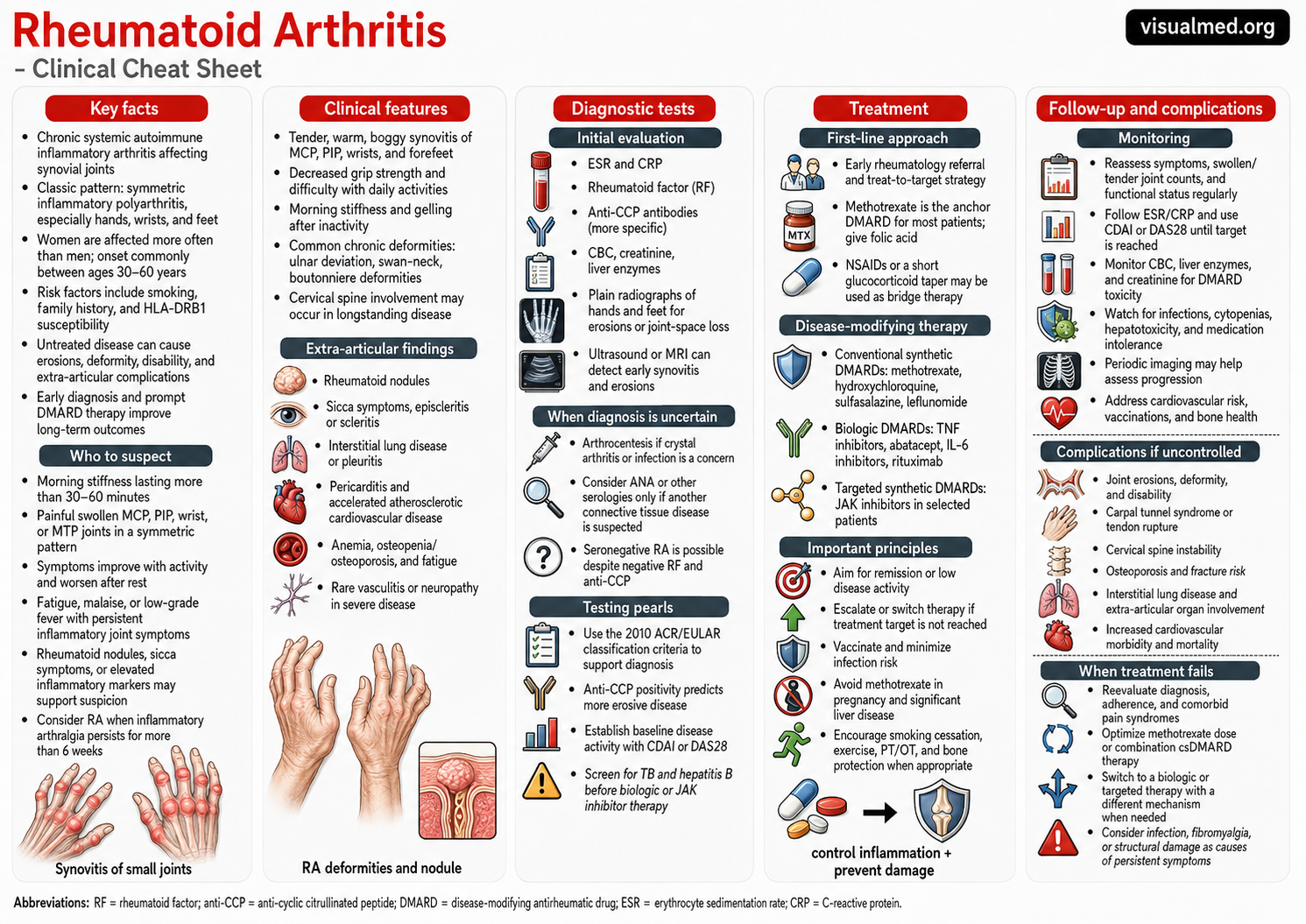
Rheumatoid arthritis (RA) is a chronic autoimmune disease that primarily affects the joints but can also involve the lungs, heart, eyes, skin, and other organs. Unlike osteoarthritis, which is largely related to mechanical wear and tear, rheumatoid arthritis is driven by persistent inflammation of the synovial lining of the joints.
Early recognition matters. Without treatment, ongoing inflammation can lead to joint erosions, deformity, disability, and systemic complications. Fortunately, modern disease-modifying therapies can dramatically reduce inflammation, prevent structural damage, and help many patients achieve remission or low disease activity.
What Is Rheumatoid Arthritis?
Rheumatoid arthritis is a systemic autoimmune inflammatory arthritis in which the immune system mistakenly attacks the synovium, the tissue lining the joints.
The typical pattern is a symmetric inflammatory polyarthritis, meaning that several joints on both sides of the body are affected.
Commonly involved joints include:
- Metacarpophalangeal joints, or MCP joints
- Proximal interphalangeal joints, or PIP joints
- Wrists
- Metatarsophalangeal joints of the feet
The distal interphalangeal joints, or DIP joints, are usually less characteristic of RA involvement.
Women are affected more frequently than men, and although rheumatoid arthritis can occur at any age, it commonly develops between approximately 30 and 60 years of age.
Smoking, genetic susceptibility, and family history can increase the risk of developing RA.
Common Symptoms of Rheumatoid Arthritis
One of the most characteristic symptoms of rheumatoid arthritis is prolonged morning stiffness.
Patients may describe stiffness lasting 30 to 60 minutes or longer after waking. Symptoms may also worsen after prolonged periods of inactivity and improve somewhat once the patient begins moving.
Other common symptoms include:
- Joint pain and tenderness
- Swollen joints
- Warm joints
- Reduced grip strength
- Difficulty opening jars or performing fine motor tasks
- Fatigue
- Malaise
- Reduced exercise tolerance
- Occasionally low-grade fever
A particularly important clue is persistent swelling of the MCP, PIP, wrist, or forefoot joints in a symmetric pattern.
Inflammatory joint symptoms that continue for more than six weeks should prompt consideration of rheumatoid arthritis, particularly when accompanied by objective synovitis.
Joint Changes and Deformities
Persistent uncontrolled inflammation can gradually damage cartilage, tendons, ligaments, and bone.
Longstanding rheumatoid arthritis can produce characteristic deformities including:
Ulnar deviation: The fingers gradually deviate toward the ulnar side of the hand.
Swan-neck deformity: Hyperextension of the PIP joint with flexion of the DIP joint.
Boutonnière deformity: Flexion of the PIP joint with hyperextension of the DIP joint.
Patients may also develop tendon rupture, carpal tunnel syndrome, and progressive functional impairment.
Modern treatment aims to prevent these changes before they occur.
Rheumatoid Arthritis Can Affect More Than the Joints
RA is a systemic inflammatory disease, and extra-articular manifestations can sometimes be clinically significant.
Rheumatoid nodules
Firm subcutaneous nodules can develop, particularly over pressure points such as the elbows.
Eye involvement
Rheumatoid arthritis may be associated with:
- Dry eyes
- Episcleritis
- Scleritis
Lung disease
RA can cause:
- Interstitial lung disease
- Pleural inflammation
- Pulmonary nodules
Interstitial lung disease is one of the more important extra-articular complications to recognize.
Cardiovascular disease
Chronic systemic inflammation contributes to an increased risk of atherosclerotic cardiovascular disease.
Patients with RA therefore require attention not only to their arthritis but also to traditional cardiovascular risk factors.
Hematologic and neurologic manifestations
RA may also be associated with anemia, peripheral neuropathy, and, rarely, inflammatory vasculitis.
Chronic inflammation and glucocorticoid exposure can also contribute to osteoporosis and fracture risk.
How Is Rheumatoid Arthritis Diagnosed?
There is no single test that definitively diagnoses rheumatoid arthritis.
Diagnosis is based on a combination of:
- History
- Physical examination
- Distribution of affected joints
- Duration of symptoms
- Serologic testing
- Inflammatory markers
- Imaging findings
Rheumatoid factor
Rheumatoid factor, or RF, is commonly measured in patients with suspected rheumatoid arthritis.
However, RF is not completely specific for RA and can be present in other autoimmune diseases, chronic infections, and even some healthy individuals.
Anti-CCP antibodies
Anti-cyclic citrullinated peptide antibodies, commonly called anti-CCP antibodies, are more specific for rheumatoid arthritis.
Anti-CCP positivity can also be associated with a greater likelihood of erosive disease.
Importantly, some patients with rheumatoid arthritis have negative RF and anti-CCP testing. This is referred to as seronegative rheumatoid arthritis.
ESR and CRP
Inflammatory markers such as:
- Erythrocyte sedimentation rate, or ESR
- C-reactive protein, or CRP
can help assess systemic inflammation and may also be followed over time to assess treatment response.
However, normal inflammatory markers do not completely exclude rheumatoid arthritis.
Additional Testing
Baseline evaluation may include:
- Complete blood count
- Kidney function
- Liver enzymes
- ESR
- CRP
- Rheumatoid factor
- Anti-CCP antibodies
These tests can help establish the diagnosis and provide baseline information before starting disease-modifying medications.
If the diagnosis remains uncertain, joint aspiration may be necessary to exclude other conditions such as:
- Gout
- Pseudogout
- Septic arthritis
Additional autoimmune testing should generally be guided by the clinical presentation rather than ordered indiscriminately.
Imaging in Rheumatoid Arthritis
Plain radiographs of the hands and feet may demonstrate:
- Joint-space narrowing
- Marginal erosions
- Periarticular osteopenia
- Chronic deformity
However, early rheumatoid arthritis may not yet produce visible abnormalities on conventional X-rays.
Ultrasound and MRI can sometimes identify:
- Synovitis
- Joint effusions
- Bone marrow inflammation
- Early erosions
before abnormalities become obvious on standard radiographs.
Why Early Treatment Matters
Perhaps the most important principle in rheumatoid arthritis management is early initiation of disease-modifying antirheumatic drug therapy.
Historically, treatment was sometimes escalated slowly after prolonged periods of symptomatic therapy. Modern practice instead emphasizes early control of inflammation.
The goal is to prevent irreversible joint damage rather than simply treating pain after damage has already occurred.
Methotrexate and First-Line Treatment
For many patients with active rheumatoid arthritis, methotrexate remains the anchor disease-modifying therapy.
It is often given with folic acid to reduce adverse effects.
Other conventional synthetic DMARDs include:
- Hydroxychloroquine
- Sulfasalazine
- Leflunomide
The choice of medication depends on disease severity, comorbidities, pregnancy plans, liver function, infection risk, and previous treatment response.
NSAIDs may help reduce pain and stiffness but do not prevent joint damage.
Short courses of glucocorticoids may occasionally be used as temporary bridge therapy while slower-acting DMARDs begin working.
Biologic and Targeted Therapies
Patients who do not achieve adequate disease control with conventional therapy may require more advanced treatment.
Biologic DMARDs include medications targeting pathways such as:
- Tumor necrosis factor, or TNF
- Interleukin-6
- T-cell activation
- B cells
Common therapeutic classes include TNF inhibitors, abatacept, IL-6 inhibitors, and rituximab.
Targeted synthetic DMARDs such as JAK inhibitors are another treatment option in appropriately selected patients.
Treatment selection should consider efficacy alongside infection risk, cardiovascular considerations, thrombotic risk, malignancy history, vaccination status, and other patient-specific factors.
Treat-to-Target Strategy
Modern rheumatoid arthritis care generally follows a treat-to-target approach.
The objective is to reach:
- Remission, or
- Low disease activity
within a reasonable period.
Disease activity may be measured using standardized tools such as:
- CDAI
- DAS28
If the treatment target is not achieved, therapy may need to be escalated, combined, or changed.
The underlying principle is straightforward:
Control inflammation early to prevent permanent joint damage later.
Monitoring Patients With Rheumatoid Arthritis
Regular follow-up is essential.
Clinicians typically assess:
- Joint pain
- Swollen joint counts
- Tender joint counts
- Morning stiffness
- Functional ability
- Patient-reported symptoms
- ESR and CRP when appropriate
Laboratory monitoring may also be necessary depending on the medication being used.
For example, patients taking methotrexate or other DMARDs may require periodic monitoring of:
- Complete blood count
- Liver enzymes
- Kidney function
Monitoring helps identify medication toxicity before serious complications develop.
Infection Risk and Vaccination
Many rheumatoid arthritis treatments suppress portions of the immune system.
Before starting certain biologic or targeted therapies, patients may require screening for infections such as:
- Tuberculosis
- Hepatitis B
Vaccination status should also be reviewed.
Ideally, appropriate vaccines are administered before significant immunosuppression whenever possible.
Lifestyle and Supportive Management
Medication remains the cornerstone of disease control, but comprehensive treatment extends beyond medications.
Helpful strategies may include:
- Regular physical activity
- Strength and flexibility exercises
- Physical therapy
- Occupational therapy
- Smoking cessation
- Maintaining a healthy body weight
- Bone health assessment
- Cardiovascular risk-factor management
Exercise is generally encouraged once inflammation is adequately controlled because maintaining muscle strength and joint mobility can improve long-term function.
Complications of Uncontrolled Rheumatoid Arthritis
Without adequate disease control, rheumatoid arthritis can lead to:
- Permanent joint erosions
- Hand and foot deformities
- Reduced mobility
- Disability
- Tendon rupture
- Carpal tunnel syndrome
- Cervical spine instability
- Osteoporosis
- Fractures
- Interstitial lung disease
- Cardiovascular disease
This is why rheumatoid arthritis should be viewed as more than simply a condition causing painful joints.
It is a systemic inflammatory disease that requires long-term management.
What If Treatment Stops Working?
Persistent symptoms do not always mean that inflammation is uncontrolled.
If a patient remains symptomatic despite therapy, clinicians may reconsider several possibilities.
These include:
- Inadequate medication dosing
- Poor adherence
- Progression of inflammatory disease
- Structural joint damage
- Osteoarthritis
- Fibromyalgia
- Infection
- Tendon or mechanical problems
If active rheumatoid arthritis remains present, treatment may be intensified by optimizing methotrexate, combining conventional DMARDs, or switching to biologic or targeted therapy with a different mechanism of action.
The Bottom Line
Rheumatoid arthritis is a chronic autoimmune disease capable of causing progressive joint destruction and systemic complications.
The major principles of modern management are:
Recognize inflammatory arthritis early. Diagnose rheumatoid arthritis promptly. Start disease-modifying therapy early. Monitor disease activity closely. Treat toward remission or low disease activity.
With early diagnosis and appropriate treatment, many patients can maintain excellent function while substantially reducing their risk of permanent joint damage.
VisualMed Clinical Pearl: Persistent symmetric swelling of the MCP, PIP, wrist, or MTP joints accompanied by prolonged morning stiffness should raise suspicion for rheumatoid arthritis, even when initial serologic testing is negative.
This article is intended for educational purposes and should not replace individualized medical evaluation or treatment.
Suggested SEO title:
Rheumatoid Arthritis: Symptoms, Diagnosis, Treatment & Complications
Meta description:
Learn the key symptoms of rheumatoid arthritis, how RA is diagnosed, the role of RF and anti-CCP antibodies, and modern treatment with DMARDs, biologics, and treat-to-target therapy.