
Glucocorticoids remain the cornerstone of treatment for polymyalgia rheumatica, but recurrent disease and long-term steroid toxicity remain major clinical problems.
The REPLENISH trial, published in the New England Journal of Medicine in 2026, evaluated whether targeting interleukin-17A with secukinumab could improve sustained remission while reducing glucocorticoid exposure.
The trial showed a substantial benefit: approximately 41% of patients receiving secukinumab achieved sustained remission compared with only 20% receiving placebo.
Why Was REPLENISH Needed?
Polymyalgia rheumatica is one of the most common inflammatory rheumatic diseases affecting older adults.
Patients typically experience substantial pain and morning stiffness involving the shoulder and hip girdles.
Glucocorticoids are highly effective at controlling symptoms initially, but treatment presents two major problems:
Relapse is common, particularly during steroid tapering.
And prolonged glucocorticoid exposure can result in substantial toxicity, including osteoporosis, diabetes, hypertension, infection, cataracts, and weight gain.
An effective steroid-sparing therapy has therefore been a major unmet need.
Secukinumab, an antibody targeting interleukin-17A, has already demonstrated efficacy across several immune-mediated inflammatory diseases.
REPLENISH evaluated whether IL-17A inhibition could provide similar benefit in relapsing PMR.
Study Design
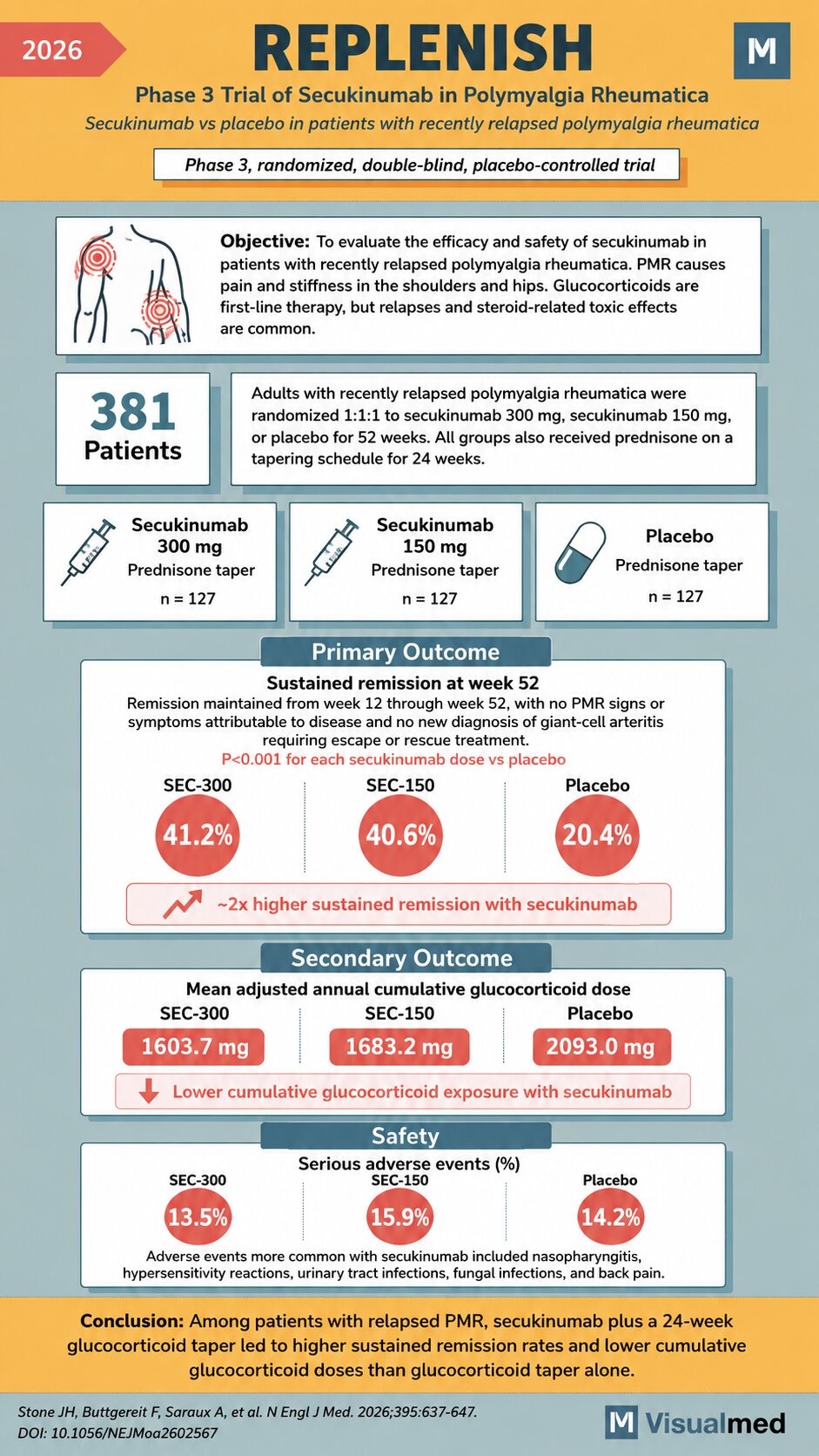
REPLENISH was a phase 3, randomized, double-blind, placebo-controlled trial involving 381 adults with recently relapsed polymyalgia rheumatica.
Patients were randomized equally to:
- Secukinumab 300 mg
- Secukinumab 150 mg
- Placebo
Each group included 127 patients.
All participants simultaneously received prednisone according to a 24-week tapering regimen.
Treatment with secukinumab or placebo continued for 52 weeks.
Primary Outcome: Sustained Remission at Week 52
The primary endpoint was sustained remission through week 52.
Sustained remission required patients to remain in remission from week 12 through week 52 without PMR-related signs or symptoms requiring escape or rescue therapy and without a new diagnosis of giant-cell arteritis.
Sustained remission occurred in:
41.2% with secukinumab 300 mg
40.6% with secukinumab 150 mg
20.4% with placebo
Both secukinumab doses were significantly superior to placebo:
P < 0.001 for each comparison
In practical terms, secukinumab approximately doubled the likelihood of sustained remission.
Interestingly, efficacy was nearly identical between the 150-mg and 300-mg doses.
Secukinumab Reduced Steroid Exposure
The benefits were not limited to remission.
Mean adjusted cumulative glucocorticoid exposure was:
1,603.7 mg with secukinumab 300 mg
1,683.2 mg with secukinumab 150 mg
2,093.0 mg with placebo
Thus, patients receiving secukinumab achieved better disease control while simultaneously requiring less cumulative glucocorticoid therapy.
For an older population particularly susceptible to steroid toxicity, this represents an important clinical advantage.
Safety
Serious adverse events occurred in:
13.5% with secukinumab 300 mg
15.9% with secukinumab 150 mg
14.2% with placebo
Overall rates of serious adverse events were therefore relatively similar across groups.
Adverse events occurring more frequently with secukinumab included:
- Nasopharyngitis
- Hypersensitivity reactions
- Urinary tract infections
- Fungal infections
- Back pain
These findings need to be considered alongside the known safety profile of IL-17 inhibition.
Why REPLENISH Matters
For decades, the therapeutic strategy for PMR has largely revolved around finding the lowest glucocorticoid dose capable of controlling disease.
REPLENISH moves treatment toward a fundamentally different model: targeted immunologic therapy capable of maintaining remission while reducing steroid exposure.
This is especially relevant for patients with repeated relapses or significant glucocorticoid-related complications.
The similarity between the two secukinumab doses is also noteworthy and may ultimately influence dosing strategies if the therapy becomes incorporated into routine PMR management.
What Does REPLENISH Mean for Clinical Practice?
The study does not suggest that every patient newly diagnosed with uncomplicated PMR requires biologic therapy.
Glucocorticoids remain highly effective for many patients.
The population studied in REPLENISH consisted specifically of patients with recently relapsed disease, a group in whom steroid dependence and cumulative toxicity become much more clinically relevant.
For such patients, secukinumab may represent an important new steroid-sparing option.
Bottom Line
The REPLENISH trial demonstrated that secukinumab substantially improves sustained remission in patients with relapsed polymyalgia rheumatica.
At 52 weeks, sustained remission occurred in approximately:
41% with secukinumab
versus
20% with placebo
Secukinumab also reduced cumulative glucocorticoid exposure without a major increase in serious adverse events.
The findings support IL-17A inhibition as a potentially important steroid-sparing strategy for relapsing PMR.
Reference:
Stone JH, Buttgereit F, Saraux A, et al. N Engl J Med. 2026;395:637–647. DOI: 10.1056/NEJMoa2602567.