
Parkinson’s disease is a progressive neurologic disorder that primarily affects movement, but its effects extend well beyond tremor and stiffness. Patients may develop changes in sleep, mood, cognition, digestion, blood pressure regulation, speech, and swallowing.
The disease develops mainly because of progressive loss of dopamine-producing neurons in a region of the brain called the substantia nigra. Dopamine plays an important role in coordinating smooth, controlled movement. As dopamine levels decline, the characteristic motor symptoms of Parkinson’s disease begin to appear.
Although there is currently no cure for Parkinson’s disease, modern treatment can substantially improve symptoms, mobility, independence, and quality of life for many patients.
What Causes Parkinson’s Disease?
In most patients, there is no single identifiable cause.
Parkinson’s disease is associated with degeneration of dopaminergic neurons in the substantia nigra and accumulation of abnormal proteins, particularly alpha-synuclein, within structures known as Lewy bodies.
Both genetic and environmental factors appear to contribute to disease development. Age is one of the strongest risk factors, and Parkinson’s disease most commonly develops after age 60, although younger patients can also be affected.
Men are diagnosed somewhat more frequently than women.
What Are the Main Symptoms of Parkinson’s Disease?
Parkinson’s disease is best known for its motor symptoms, but patients frequently experience important non-motor symptoms as well.
Bradykinesia
Bradykinesia, or slowness of movement, is one of the defining features of Parkinson’s disease.
Patients may notice that everyday activities such as getting dressed, walking, getting out of a chair, shaving, or preparing food take longer than before.
Repeated movements may also become progressively slower or smaller.
Resting Tremor
A classic Parkinson’s tremor typically occurs when the affected limb is at rest.
It often begins in one hand and may have a characteristic “pill-rolling” appearance, involving rhythmic movement of the thumb and fingers.
The tremor usually decreases when the hand is intentionally used.
Importantly, not every patient with Parkinson’s disease develops a prominent tremor.
Rigidity
Muscles may become stiff and resistant to movement.
During examination, clinicians may detect cogwheel rigidity, in which the limb seems to move through a series of small catches rather than smoothly.
Changes in Walking and Balance
Patients may develop:
- Short, shuffling steps
- Reduced arm swing
- Difficulty turning
- Stooped posture
- Freezing episodes
- A tendency to accelerate involuntarily while walking, known as festination
Balance problems and falls tend to become more prominent later in the disease.
Other Motor Features
Parkinson’s disease can also cause several more subtle changes.
Patients may develop a softer voice, known as hypophonia, reduced facial expression or “masked facies,” difficulty initiating movement, and progressively smaller handwriting known as micrographia.
These findings can sometimes appear before patients or family members recognize that a movement disorder is developing.
Parkinson’s Disease Is More Than a Movement Disorder
Some of the most important symptoms of Parkinson’s disease are actually non-motor symptoms.
These may occur years before the classic motor symptoms appear.
Loss of Smell
Reduced sense of smell, or hyposmia, is common and can precede motor symptoms by many years.
Constipation
Constipation is extremely common and may develop long before Parkinson’s disease is diagnosed.
REM Sleep Behavior Disorder
Normally, the body remains relatively still during REM sleep.
Patients with REM sleep behavior disorder may physically act out their dreams, including talking, kicking, punching, or moving during sleep.
This can precede the development of Parkinson’s disease.
Mood Changes
Depression, anxiety, apathy, and fatigue are common.
These symptoms are not simply psychological reactions to having a chronic illness; they can be part of the neurologic disease itself.
Autonomic Dysfunction
Parkinson’s disease can affect the autonomic nervous system.
Patients may develop:
- Orthostatic hypotension
- Urinary symptoms
- Constipation
- Sexual dysfunction
- Abnormal sweating
Cognitive Changes
Cognitive impairment may occur later in the disease.
Some patients develop hallucinations or Parkinson’s disease dementia, particularly after living with the condition for many years.
How Is Parkinson’s Disease Diagnosed?
There is no single blood test that confirms Parkinson’s disease.
The diagnosis is primarily clinical, based on the patient’s history and neurologic examination.
A typical diagnosis requires bradykinesia along with another characteristic feature such as resting tremor or rigidity.
Clinicians also look for supportive findings, including asymmetry of symptoms and improvement after treatment with levodopa.
Are Brain Scans Needed?
Most patients with typical Parkinson’s disease do not require specialized imaging to establish the diagnosis.
An MRI may be performed when clinicians are concerned about another neurologic disorder.
In selected cases where the diagnosis remains uncertain, dopamine transporter imaging, commonly called a DaTscan, may help determine whether there is reduced presynaptic dopaminergic activity.
However, a DaTscan does not independently diagnose Parkinson’s disease and must be interpreted alongside the clinical presentation.
Conditions That Can Mimic Parkinson’s Disease
Not everyone with tremor or slowed movement has Parkinson’s disease.
Other possibilities include:
- Essential tremor
- Medication-induced parkinsonism
- Vascular parkinsonism
- Normal-pressure hydrocephalus
- Multiple system atrophy
- Progressive supranuclear palsy
- Other atypical parkinsonian disorders
Certain medications, particularly some antipsychotic drugs and medications such as metoclopramide, can produce parkinsonian symptoms.
Treatment of Parkinson’s Disease
Treatment is individualized according to age, symptoms, functional limitations, occupation, cognitive status, and medication side effects.
The goal is not simply to eliminate tremor. Treatment aims to preserve mobility, independence, safety, and quality of life.
Exercise
Regular physical activity is one of the most important components of Parkinson’s disease management.
Exercise can help maintain:
- Strength
- Flexibility
- Balance
- Walking ability
- Cardiovascular health
- Independence
Physical therapy may be especially helpful for gait abnormalities, balance problems, freezing, and fall prevention.
Carbidopa/Levodopa
Levodopa remains the most effective medication for the motor symptoms of Parkinson’s disease.
Levodopa enters the brain and is converted into dopamine.
It is usually given together with carbidopa, which reduces conversion of levodopa outside the brain and helps decrease side effects such as nausea.
Many patients experience substantial improvement in bradykinesia and rigidity, and often in tremor as well.
Other Parkinson’s Medications
Other medications may be used alone or alongside levodopa.
These include:
MAO-B inhibitors, which reduce dopamine breakdown.
Dopamine agonists, which stimulate dopamine receptors directly.
COMT inhibitors, which can prolong the effect of levodopa.
Amantadine, which may be particularly useful for reducing dyskinesias in selected patients.
Medication selection depends heavily on the individual patient.
Wearing-Off and Dyskinesias
As Parkinson’s disease progresses, patients taking levodopa may notice that each dose does not last as long as it once did.
This phenomenon is known as wearing-off.
Some patients also develop involuntary movements called dyskinesias.
Treatment may involve adjusting the timing or dose of levodopa or adding medications that extend its effect.
Deep Brain Stimulation
For selected patients, deep brain stimulation (DBS) can significantly improve motor symptoms.
DBS involves surgically implanting electrodes into specific areas of the brain.
It may be considered when patients continue to respond to levodopa but develop disabling fluctuations, dyskinesias, or medication-resistant tremor.
Patient selection is extremely important, and factors such as cognition and overall health must be considered.
Other advanced therapies, including continuous medication infusion systems, may also be considered in certain patients.
Long-Term Monitoring
Parkinson’s disease changes over time, so treatment must evolve as well.
Follow-up commonly focuses on:
- Tremor, stiffness, and bradykinesia
- Walking and falls
- Medication duration and wearing-off
- Dyskinesias
- Cognition
- Mood
- Sleep
- Swallowing
- Blood pressure symptoms
- Constipation
- Weight and nutrition
Driving safety, caregiver burden, and future care planning may also become increasingly important as the disease progresses.
Potential Complications
Advanced Parkinson’s disease may lead to significant complications.
These can include:
- Falls and fractures
- Severe gait freezing
- Loss of independence
- Dysphagia
- Aspiration pneumonia
- Malnutrition
- Dementia
- Hallucinations or psychosis
- Orthostatic hypotension
- Urinary dysfunction
Early recognition of these problems allows clinicians to address them before they cause additional harm.
A Multidisciplinary Approach Matters
Parkinson’s disease is rarely managed with medication alone.
Patients may benefit from a team that includes neurologists, physical therapists, occupational therapists, speech-language pathologists, dietitians, mental health professionals, and caregivers.
Speech therapy can help with both voice changes and swallowing difficulties, while occupational therapy can help patients adapt daily activities and maintain independence.
The Bottom Line
Parkinson’s disease is a progressive neurodegenerative disorder caused primarily by loss of dopamine-producing neurons in the brain.
The major motor features are bradykinesia, resting tremor, rigidity, and eventually problems with gait and balance, but non-motor symptoms such as constipation, sleep disturbance, depression, autonomic dysfunction, and cognitive changes are equally important.
Diagnosis is primarily clinical. Treatment typically combines exercise, rehabilitation, medications such as carbidopa/levodopa, and advanced therapies such as deep brain stimulation in selected patients.
There is currently no established treatment that completely stops Parkinson’s disease progression, but effective symptom management can allow many people with Parkinson’s disease to remain active and independent for years.
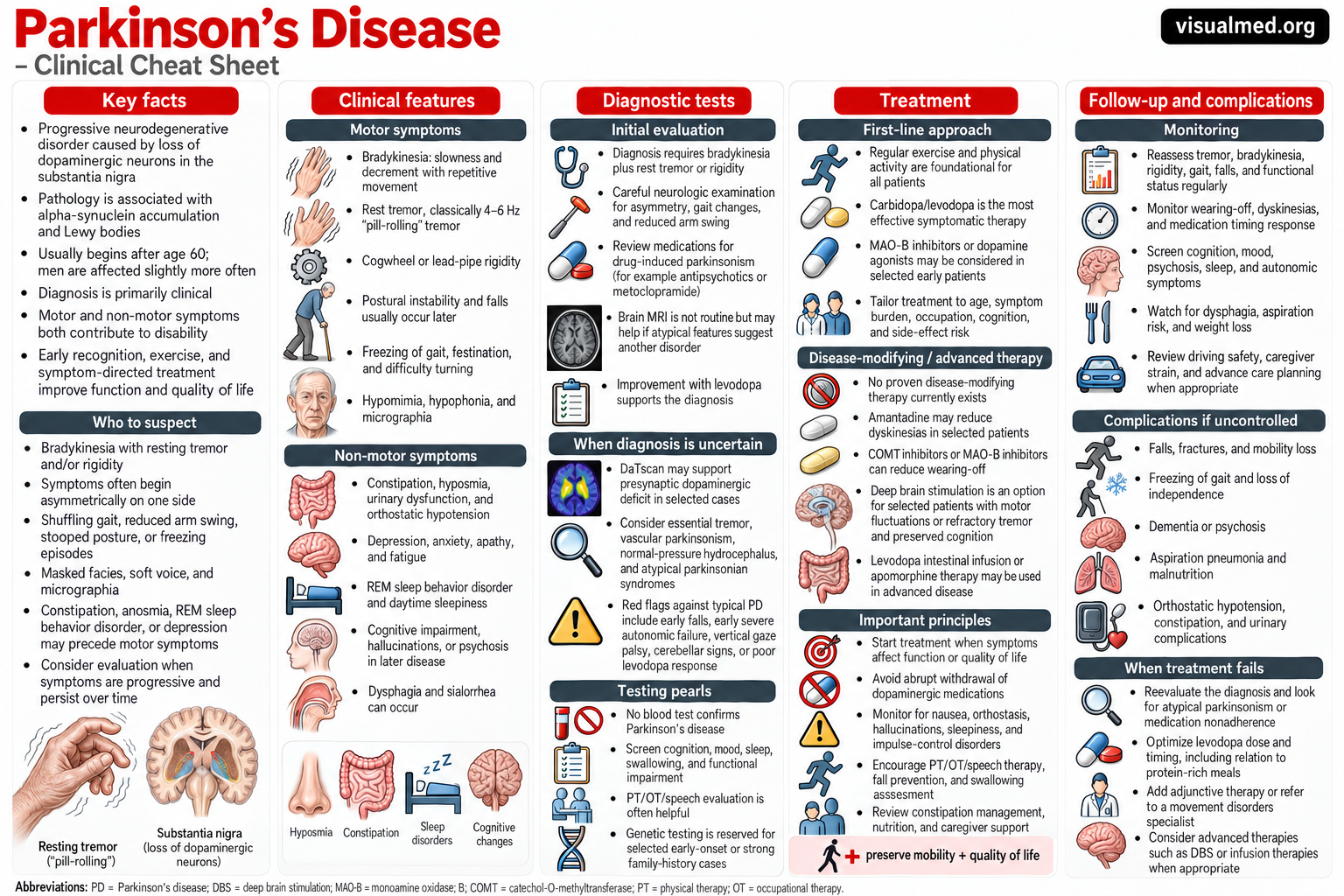
VisualMed Clinical Cheat Sheet: Use the accompanying Parkinson’s disease visual summary for a rapid review of clinical features, diagnosis, treatment, monitoring, and complications.
This article is intended for medical education and general informational purposes and should not replace individualized medical evaluation or treatment.