
Acute kidney injury remains one of the most frequent complications following cardiac surgery and is associated with prolonged hospitalization, greater morbidity, and worse long-term outcomes.
Given the growing evidence that SGLT2 inhibitors have kidney-protective effects in chronic cardiovascular and renal disease, investigators have begun asking whether these benefits might extend into the perioperative setting.
The MERCURI-2 trial, published in JAMA in 2026, evaluated a short perioperative course of dapagliflozin in patients undergoing elective cardiac surgery.
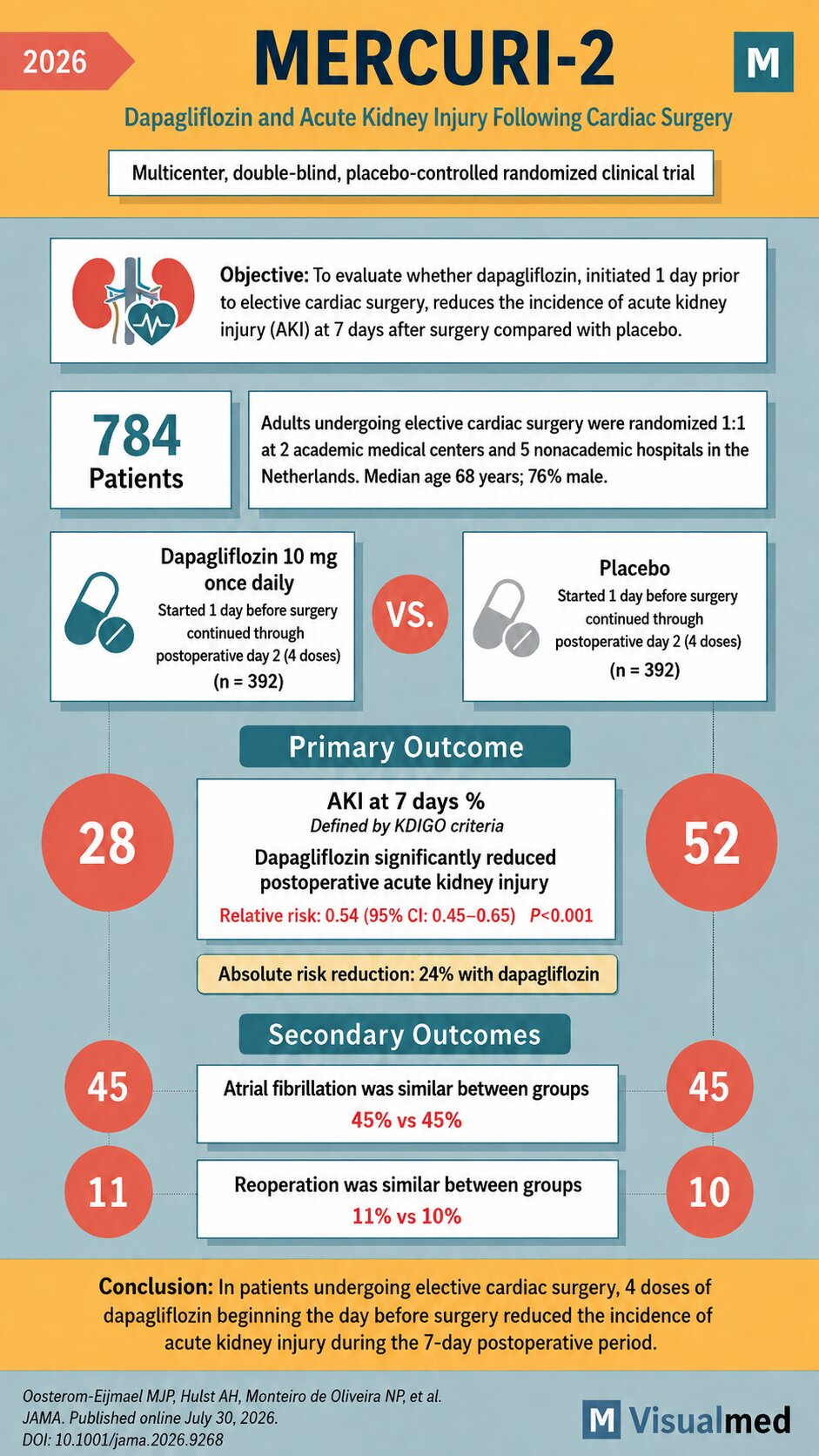
The results were striking: dapagliflozin reduced postoperative acute kidney injury from 52% to 28%.
Why Was MERCURI-2 Needed?
Cardiac surgery creates a perfect storm for kidney injury.
Cardiopulmonary bypass, hemodynamic instability, inflammation, oxidative stress, venous congestion, and perioperative medication exposure can all contribute to postoperative AKI.
Despite its frequency, few pharmacologic strategies have convincingly prevented AKI after cardiac surgery.
SGLT2 inhibitors such as dapagliflozin have demonstrated broad cardiovascular and renal benefits in patients with diabetes, chronic kidney disease, and heart failure.
MERCURI-2 asked whether these kidney-protective effects could also be harnessed during the short but high-risk period surrounding cardiac surgery.
Study Design
MERCURI-2 was a multicenter, double-blind, placebo-controlled randomized clinical trial conducted at seven hospitals in the Netherlands.
A total of 784 adults undergoing elective cardiac surgery were randomized 1:1.
The median patient age was 68 years, and approximately 76% were men.
Participants received either:
Dapagliflozin 10 mg once daily
or
Placebo
Treatment began one day before surgery and continued through postoperative day 2, for a total of four doses.
Each group included 392 patients.
Primary Outcome: Major Reduction in Postoperative AKI
The primary endpoint was acute kidney injury within seven days of surgery, defined according to KDIGO criteria.
AKI occurred in:
28% of patients receiving dapagliflozin
versus
52% receiving placebo
This corresponded to:
Relative risk: 0.54
95% CI: 0.45–0.65
P < 0.001
The absolute risk reduction was 24 percentage points.
That translates to an approximate number needed to treat of just over 4 patients to prevent one episode of postoperative AKI, based on the observed event rates.
For a perioperative intervention consisting of only four doses, the magnitude of benefit is notable.
Secondary Outcomes
Not every postoperative outcome differed between groups.
Postoperative atrial fibrillation occurred in:
45% with dapagliflozin vs 45% with placebo
Reoperation occurred in:
11% vs 10%
Thus, the apparent treatment effect was primarily centered on kidney injury rather than a generalized reduction in postoperative complications.
Why Might Dapagliflozin Protect the Kidney?
The mechanisms remain an important area of study.
SGLT2 inhibitors alter renal sodium and glucose handling, reduce intraglomerular pressure, modify tubuloglomerular feedback, and may improve renal metabolic efficiency.
They may also favorably influence inflammation and cellular stress pathways.
Whether the striking reduction in postoperative AKI observed in MERCURI-2 is driven by these mechanisms—or by additional perioperative effects—will require further investigation.
Does This Change Perioperative SGLT2 Management?
This is where the trial becomes particularly provocative.
Clinicians have traditionally been cautious about SGLT2 inhibitors in the perioperative period because of concerns about euglycemic diabetic ketoacidosis, fasting, hemodynamic shifts, and volume status.
MERCURI-2 therefore challenges conventional thinking by deliberately initiating dapagliflozin before cardiac surgery.
However, one trial should not automatically lead clinicians to abandon established perioperative safety protocols.
The magnitude of the renal benefit is compelling, but broader validation and careful examination of perioperative safety will be important before this strategy becomes routine practice.
What Does MERCURI-2 Mean for Clinical Practice?
MERCURI-2 provides strong proof-of-concept evidence that SGLT2 inhibition may become a targeted strategy for preventing cardiac surgery–associated AKI.
Unlike many previous interventions directed at postoperative AKI, the treatment was inexpensive, familiar to cardiovascular clinicians, and remarkably short.
If replicated, the findings could potentially establish a completely new perioperative indication for SGLT2 inhibitors.
Bottom Line
The MERCURI-2 trial randomized 784 patients undergoing elective cardiac surgery to four doses of dapagliflozin or placebo beginning one day before surgery.
Postoperative AKI occurred in:
28% with dapagliflozin vs 52% with placebo
representing a 46% relative reduction and 24% absolute reduction in risk.
The study suggests that a very short course of dapagliflozin may substantially reduce cardiac surgery–associated acute kidney injury.
For cardiovascular medicine, this is one of the more provocative perioperative applications of SGLT2 inhibitors to emerge in recent years.
Reference:
Oosterom-Eijmael MJP, Hulst AH, Monteiro de Oliveira NP, et al. JAMA. Published online July 30, 2026. DOI: 10.1001/jama.2026.9268.