
Patients with atrial fibrillation who experience an ischemic stroke are typically treated with oral anticoagulation to reduce the risk of recurrent cardioembolic events. However, management becomes more complicated when the same patient also has significant atherosclerotic cardiovascular disease.
Could adding an antiplatelet agent to anticoagulation provide additional protection against recurrent ischemic events?
The ATIS-NVAF trial examined this question and found that combination antithrombotic therapy did not provide a significant net clinical benefit over anticoagulation alone and substantially increased bleeding risk.
Study Overview
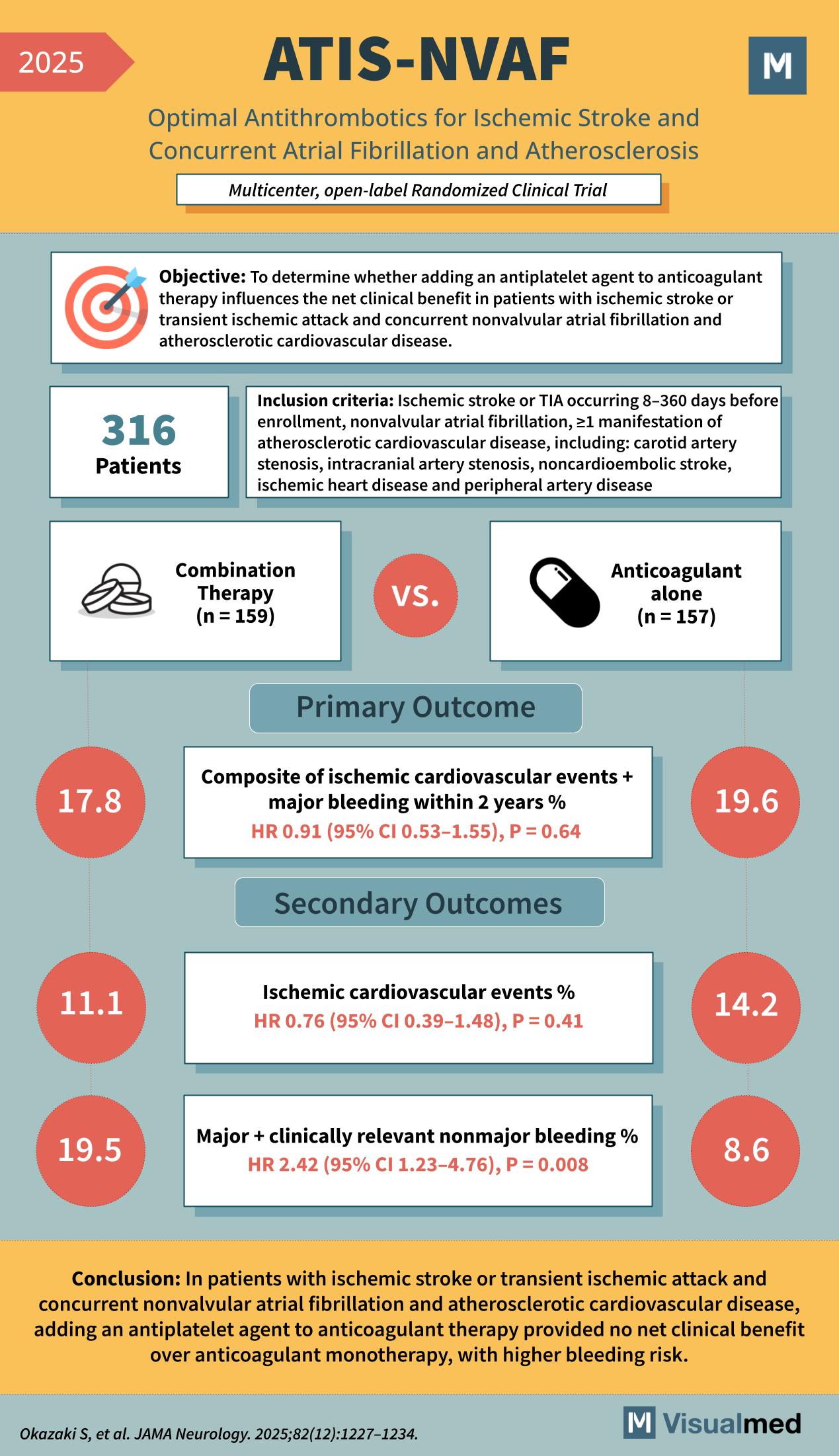
ATIS-NVAF was a multicenter, open-label randomized clinical trial evaluating patients with a recent ischemic stroke or transient ischemic attack who had both nonvalvular atrial fibrillation and evidence of atherosclerotic cardiovascular disease.
A total of 316 patients were randomized to one of two treatment strategies:
- Combination therapy: anticoagulation plus an antiplatelet agent — 159 patients
- Anticoagulation alone: 157 patients
Eligible patients had experienced an ischemic stroke or TIA 8 to 360 days before enrollment and had at least one manifestation of atherosclerotic cardiovascular disease, including carotid stenosis, intracranial arterial stenosis, noncardioembolic stroke, ischemic heart disease, or peripheral arterial disease.
The primary question was whether adding antiplatelet therapy to anticoagulation would improve overall clinical outcomes without causing an unacceptable increase in bleeding.
Primary Outcome
The primary endpoint was a composite of ischemic cardiovascular events and major bleeding within 2 years.
The endpoint occurred in:
17.8% of patients receiving combination therapy versus 19.6% receiving anticoagulation alone.
HR 0.91; 95% CI 0.53–1.55; P = 0.64
There was therefore no statistically significant improvement in net clinical benefit from adding an antiplatelet agent.
Ischemic Cardiovascular Events
Ischemic cardiovascular events occurred in:
11.1% of patients receiving combination therapy versus 14.2% receiving anticoagulation alone.
HR 0.76; 95% CI 0.39–1.48; P = 0.41
Although the numerical event rate was lower with combination therapy, the difference was not statistically significant.
Importantly, any potential reduction in ischemic events had to be weighed against the increased risk of bleeding.
Bleeding Risk Increased Significantly
The clearest difference between the two strategies was bleeding.
Major or clinically relevant nonmajor bleeding occurred in:
19.5% of patients receiving combination therapy compared with 8.6% receiving anticoagulation alone.
HR 2.42; 95% CI 1.23–4.76; P = 0.008
Thus, adding antiplatelet therapy resulted in more than twice the hazard of clinically important bleeding.
This increase in bleeding effectively eliminated any potential benefit suggested by the numerically lower ischemic event rate.
Clinical Interpretation
ATIS-NVAF addresses an important therapeutic dilemma. Patients with atrial fibrillation may have multiple potential mechanisms for ischemic stroke. While anticoagulation targets thromboembolism related to atrial fibrillation, clinicians may be tempted to add antiplatelet therapy when significant carotid, intracranial, coronary, or peripheral atherosclerosis is also present.
The trial suggests that routinely intensifying therapy in this manner may not improve overall outcomes.
While combination therapy produced a numerical reduction in ischemic events, this did not reach statistical significance, whereas the increase in clinically relevant bleeding was substantial and statistically significant.
The results therefore support a strategy of anticoagulation alone for many patients with atrial fibrillation and stable concomitant atherosclerotic disease, unless there is a separate established indication for antiplatelet therapy.
Situations such as recent acute coronary syndrome, recent PCI, or coronary stenting remain distinct clinical scenarios in which temporary combination antithrombotic therapy may still be appropriate.
Take-Home Message
The ATIS-NVAF trial found that among patients with previous ischemic stroke or TIA, nonvalvular atrial fibrillation, and concomitant atherosclerotic cardiovascular disease:
Adding an antiplatelet agent to anticoagulation did not significantly reduce the composite of ischemic cardiovascular events and major bleeding.
Ischemic cardiovascular events were not significantly reduced, while major or clinically relevant nonmajor bleeding increased from 8.6% to 19.5%.
For patients without another compelling indication for antiplatelet therapy, these findings reinforce the principle that more antithrombotic therapy is not necessarily better.
Reference
Okazaki S, et al. Optimal Antithrombotics for Ischemic Stroke and Concurrent Atrial Fibrillation and Atherosclerosis (ATIS-NVAF). JAMA Neurology. 2025;82(12):1227–1234.