
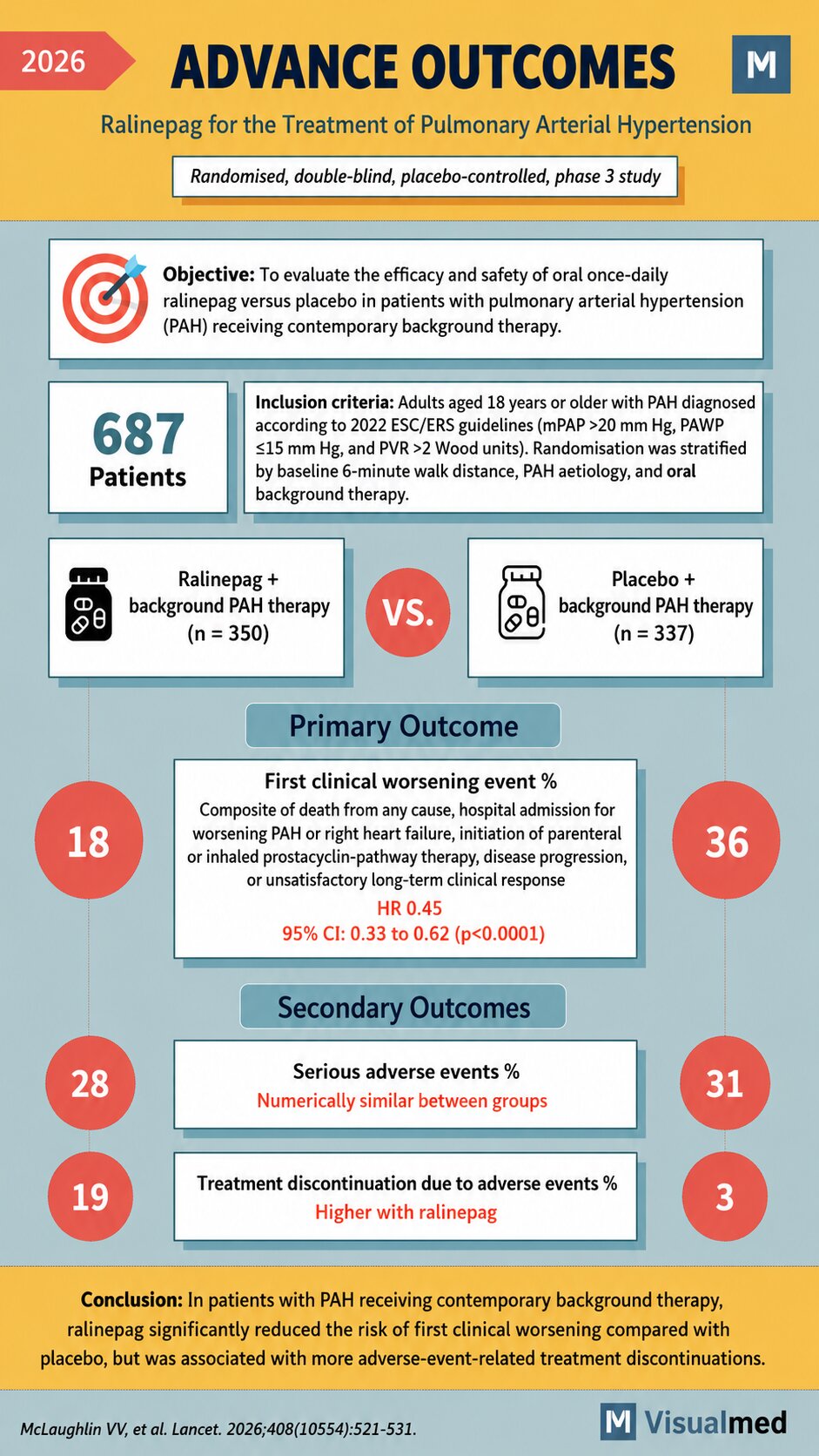
A new phase 3 trial published in The Lancet suggests that ralinepag, an oral once-daily selective prostacyclin IP receptor agonist, can substantially reduce the risk of clinical worsening in patients with pulmonary arterial hypertension (PAH) already receiving contemporary background therapy.
The ADVANCE OUTCOMES trial evaluated whether adding ralinepag to existing PAH treatment could improve long-term clinical outcomes compared with placebo.
Why This Trial Matters
Pulmonary arterial hypertension is a progressive disease characterized by increased pulmonary vascular resistance, progressive right ventricular dysfunction, and premature mortality.
Modern PAH treatment increasingly relies on combination therapy targeting several pathways involved in pulmonary vascular disease. Prostacyclin-pathway therapies are effective but can be challenging to administer, particularly when delivered intravenously, subcutaneously, or by inhalation.
Ralinepag was developed as an oral, once-daily prostacyclin IP receptor agonist, potentially offering a more convenient way to target this pathway.
ADVANCE OUTCOMES Trial Design
ADVANCE OUTCOMES was a:
- Randomized
- Double-blind
- Placebo-controlled
- Event-driven
- Phase 3 trial
Adults with PAH diagnosed according to contemporary ESC/ERS hemodynamic criteria were randomized 1:1 to receive either ralinepag or placebo, in addition to their existing PAH therapy.
Ralinepag was initiated at 50 μg once daily and titrated weekly to the highest individually tolerated dose.
The primary outcome was time to first clinical worsening event, defined as a composite of:
- Death from any cause
- Hospitalization for worsening PAH or right-heart failure
- Initiation of parenteral or inhaled prostacyclin-pathway therapy
- Disease progression
- Unsatisfactory long-term clinical response
A total of 687 patients were included in the primary efficacy and safety analyses:
Ralinepag: 350 patients
Placebo: 337 patients
Importantly, 80% of participants were already receiving dual background PAH therapy, making the study particularly relevant to contemporary clinical practice.
Ralinepag Significantly Reduced Clinical Worsening
The primary endpoint strongly favored ralinepag.
A first clinical worsening event occurred in:
18% with ralinepag
vs
36% with placebo
This corresponded to:
Hazard ratio: 0.45
95% CI: 0.33–0.62
P <0.0001
In other words, treatment with ralinepag was associated with an approximately 55% relative reduction in the risk of first clinical worsening.
The largest numerical differences between the groups were seen in disease progression, initiation of parenteral or inhaled prostacyclin therapy, and unsatisfactory long-term clinical response.
Safety and Treatment Discontinuation
Serious adverse events were relatively similar between groups:
Ralinepag: 28%
Placebo: 31%
However, treatment tolerability was an important limitation.
Adverse events led to treatment discontinuation in:
19% of patients receiving ralinepag
compared with
3% receiving placebo
Adverse events leading to death occurred in approximately 4% of patients in both groups.
Therefore, although ralinepag demonstrated significant efficacy, clinicians will need to balance its clinical benefits against the higher likelihood of treatment-limiting adverse effects.
What Does ADVANCE OUTCOMES Mean for PAH Treatment?
The results are notable because most participants were already receiving contemporary background therapy.
Despite this, adding ralinepag substantially reduced the risk of clinical deterioration.
The findings strengthen the evidence supporting earlier and broader targeting of the prostacyclin pathway in PAH and suggest that an oral once-daily agent may provide another option for patients who require escalation beyond existing therapy.
The convenience of oral administration could also be clinically meaningful compared with more complex parenteral or inhaled prostacyclin therapies.
Key Takeaway
ADVANCE OUTCOMES demonstrated that ralinepag significantly reduced clinical worsening in patients with pulmonary arterial hypertension receiving contemporary background therapy.
Clinical worsening occurred in 18% of patients treated with ralinepag versus 36% receiving placebo, corresponding to a 55% relative reduction in risk.
However, adverse-event-related treatment discontinuation was considerably more frequent with ralinepag.
Overall, the study supports ralinepag as a potentially important oral prostacyclin-pathway treatment option for PAH, while highlighting the importance of individualized dose titration and tolerability.
Reference: McLaughlin VV, et al. Ralinepag for the treatment of pulmonary arterial hypertension (ADVANCE OUTCOMES): a randomised, double-blind, placebo-controlled phase 3 study. Lancet. 2026;408(10554):521–531.