
Deep brain stimulation (DBS) is an established therapy for patients with Parkinson disease (PD) whose symptoms are inadequately controlled with medication. Conventional DBS, however, generally delivers stimulation continuously at a fixed programmed amplitude—even though Parkinson symptoms and underlying brain activity fluctuate throughout the day.
The ADAPT-PD trial, published in JAMA Neurology in 2025, evaluated whether adaptive deep brain stimulation (aDBS) could safely and effectively provide long-term, at-home therapy by automatically adjusting stimulation in response to a patient’s neural activity.
What Is Adaptive Deep Brain Stimulation?
Traditional continuous DBS (cDBS) delivers stimulation at relatively fixed settings. Adaptive DBS takes a more personalized, closed-loop approach.
The system continuously monitors local field potentials from the implanted DBS electrodes and modifies stimulation amplitude according to changes in selected neural signals. In ADAPT-PD, frequencies within the alpha-beta range were used as personalized biomarkers to guide stimulation. The potential advantage is that stimulation can increase or decrease as the patient’s neural state changes rather than delivering the same amount of stimulation continuously.
Researchers evaluated two adaptive approaches:
- Single-threshold adaptive DBS (ST-aDBS)
- Dual-threshold adaptive DBS (DT-aDBS)
The goal was primarily to determine whether patients could maintain effective symptom control with long-term adaptive stimulation while potentially reducing unnecessary electrical stimulation.
ADAPT-PD Trial Design
ADAPT-PD was an international, prospective clinical trial involving patients with moderate-to-advanced Parkinson disease who were already stable on continuous DBS and medication.
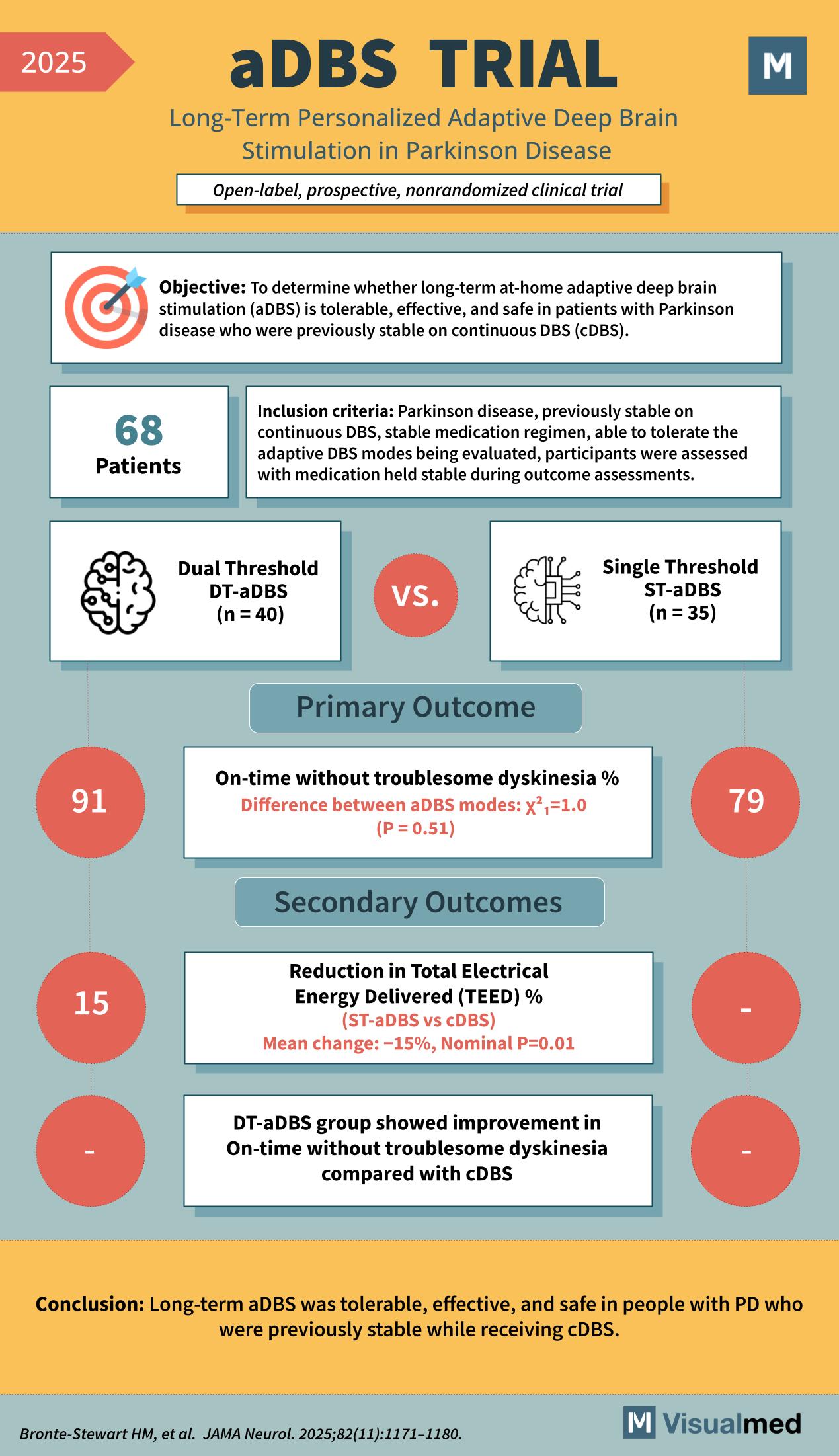
A total of 68 patients were enrolled, with a mean age of 62 years. Approximately 75% had stimulation targeting the subthalamic nucleus and 25% the globus pallidus internus.
Patients underwent a period of adaptive DBS programming and adjustment. Those able to tolerate both adaptive modes underwent evaluation of both ST-aDBS and DT-aDBS, while patients who tolerated only one mode were evaluated with that mode. This explains why the reported DT-aDBS and ST-aDBS groups overlap rather than adding up to the original 68 participants.
Overall, 40 patients were evaluated with DT-aDBS and 35 with ST-aDBS. Thirty participants tolerated both modes.
The primary outcome focused on “on-time without troublesome dyskinesia”—the amount of the day during which Parkinson symptoms were adequately controlled without disabling involuntary movements.
Primary Outcome: Symptom Control Maintained With Adaptive DBS
The study found that most patients maintained clinically comparable good “on-time” with adaptive stimulation compared with their previous continuous DBS therapy.
Using the revised post hoc performance threshold of no more than a two-hour-per-day reduction in on-time without troublesome dyskinesia:
91% of patients receiving DT-aDBS met the performance goal.
79% of patients receiving ST-aDBS met the performance goal.
There was no significant difference between the two adaptive modes (P = 0.51).
These findings suggest that adaptive stimulation can provide symptom control comparable to conventional continuous stimulation for many appropriately selected patients.
Importantly, the trial was designed primarily around achieving a performance threshold rather than demonstrating that adaptive DBS was superior to continuous DBS.
Adaptive DBS May Reduce Energy Use
One potential benefit of a system that stimulates only as much as necessary is lower electrical energy consumption.
In the trial, ST-aDBS reduced total electrical energy delivered by approximately 15% compared with continuous DBS, with a nominal P value of 0.01. DT-aDBS did not demonstrate the same significant reduction.
Reducing the amount of stimulation delivered could theoretically help decrease stimulation-related adverse effects and extend neurostimulator battery life, although these potential long-term advantages require further investigation.
Patients Preferred to Continue Adaptive DBS
Patient acceptance was also notable.
Of the 52 patients who entered the adaptive DBS setup phase, 45 tolerated at least one adaptive mode. After completing the evaluation period, 44 of those 45 patients—98%—chose to continue receiving adaptive DBS during long-term follow-up.
Most stimulation-related adverse events occurred during programming and adjustment and resolved during that phase. No serious device-related adverse events were reported during long-term follow-up.
Why This Trial Matters
Adaptive DBS represents an important evolution from continuous stimulation toward personalized, closed-loop neuromodulation.
Parkinson disease symptoms change throughout the day because of medication cycles, activity, sleep, stress, and underlying fluctuations in neural activity. A DBS system capable of sensing those changes and responding in real time could theoretically provide more physiologic stimulation than continuously delivering a fixed amplitude.
ADAPT-PD is particularly important because earlier adaptive DBS studies were generally small and performed over relatively short periods under controlled conditions. This study demonstrated that personalized adaptive stimulation could be used chronically and at home, rather than only experimentally in the laboratory.
Important Limitations
The findings should nevertheless be interpreted carefully. Participants and investigators were not blinded to whether adaptive DBS was being used, which introduces the possibility of expectation or placebo effects. The primary analysis also ultimately relied on a post hoc revised performance threshold, meaning the results cannot be interpreted as a conventional confirmatory superiority trial.
Additionally, these patients had already been successfully treated with conventional DBS and were selected based on their ability to generate neural signals suitable for adaptive stimulation. The results therefore may not apply to every patient receiving DBS.
Conclusion
The ADAPT-PD trial provides important evidence that long-term adaptive deep brain stimulation is technically feasible, well tolerated, and capable of maintaining effective symptom control in appropriately selected patients with Parkinson disease who were previously stable on continuous DBS.
Dual-threshold aDBS met the symptom-control performance goal in 91% of evaluated patients, while single-threshold aDBS did so in 79%. ST-aDBS also reduced total electrical energy delivery by approximately 15%.
Perhaps most strikingly, 44 of 45 patients who completed adaptive DBS evaluation elected to continue using it.
Rather than continuously stimulating the brain at essentially fixed settings, future DBS systems may increasingly sense neural activity and dynamically deliver stimulation according to an individual patient’s needs.
Reference: Bronte-Stewart HM, Beudel M, Ostrem JL, et al. Long-Term Personalized Adaptive Deep Brain Stimulation in Parkinson Disease: A Nonrandomized Clinical Trial. JAMA Neurol. 2025;82(11):1171–1180. doi:10.1001/jamaneurol.2025.2781