
Whether statins should be continued indefinitely in older adults without established cardiovascular disease remains one of the more uncertain areas of preventive cardiology.
Randomized statin trials have demonstrated clear cardiovascular benefit in many populations, but adults older than 75 years—particularly those receiving statins exclusively for primary prevention—have historically been underrepresented.
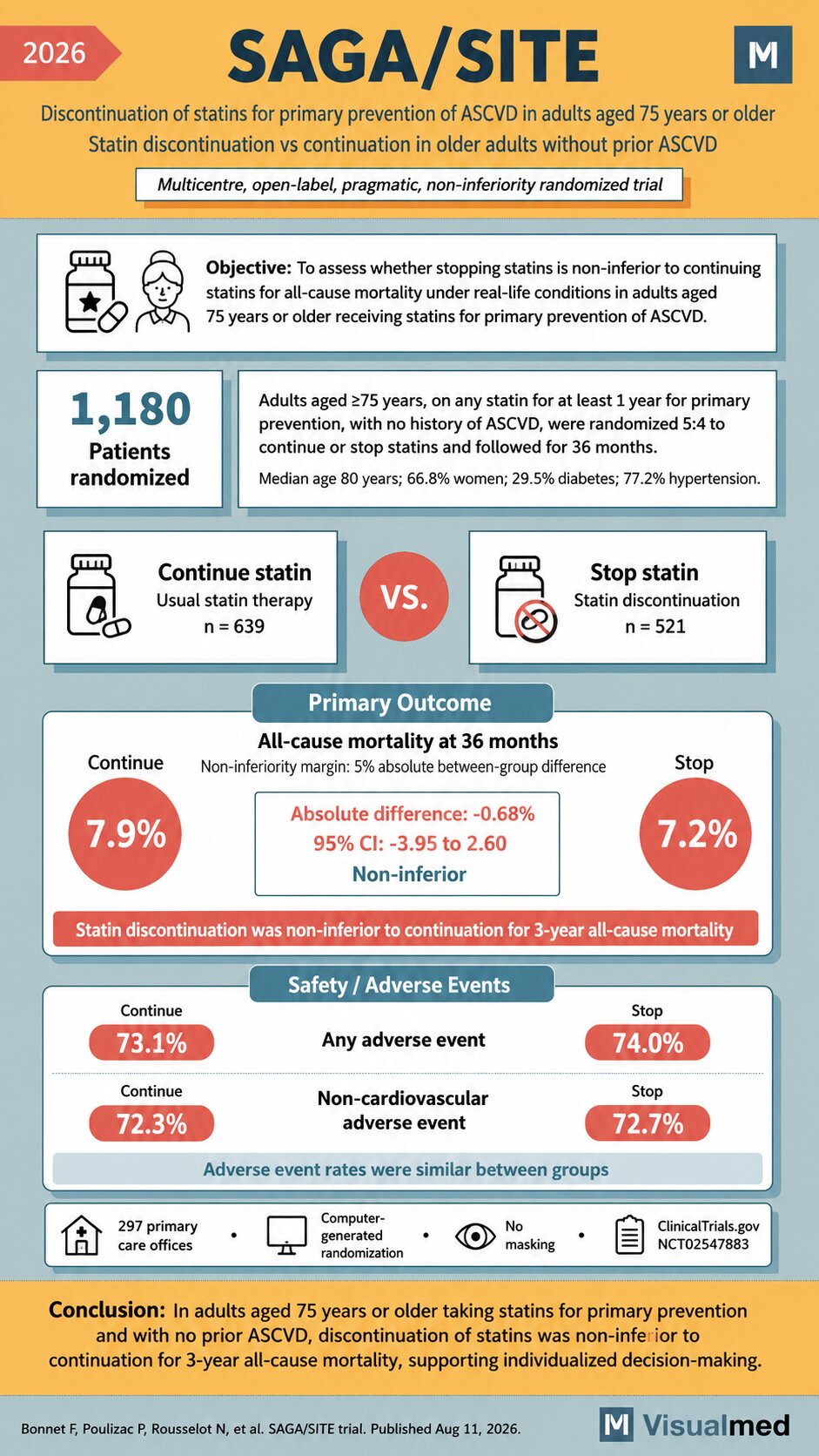
The SAGA/SITE trial, published in 2026, directly tested whether discontinuing statins in adults aged 75 years or older was non-inferior to continuing therapy.
At three years, stopping statin therapy was non-inferior to continuing statins for all-cause mortality.
Why Was SAGA/SITE Needed?
The decision to initiate or continue preventive therapies becomes increasingly complex with age.
Older adults may face:
- Polypharmacy
- Drug interactions
- Frailty
- Competing causes of mortality
- Medication burden
- Changes in treatment priorities
- Uncertainty about how long preventive benefit takes to emerge
For secondary prevention, the benefit of statin therapy remains well established.
The uncertainty is greatest among older adults who have never experienced ASCVD and are taking a statin exclusively to prevent a first cardiovascular event.
SAGA/SITE asked a pragmatic question:
Among adults aged 75 years or older receiving statins for primary prevention, is stopping treatment non-inferior to continuing it?
Study Design
SAGA/SITE was a multicenter, open-label, pragmatic, randomized non-inferiority trial.
A total of 1,180 adults aged 75 years or older were enrolled.
Patients had:
- Taken a statin for at least one year
- No history of established ASCVD
- Statin therapy being used for primary prevention
Participants were randomized to:
Continue statin therapy: 639 patients
or
Stop statin therapy: 521 patients
Median age was 80 years.
Approximately 66.8% were women, 29.5% had diabetes, and 77.2% had hypertension.
Patients were followed for 36 months.
Primary Outcome: All-Cause Mortality
The primary endpoint was all-cause mortality at three years.
Mortality occurred in:
7.9% of patients continuing statins
versus
7.2% of patients stopping statins
The absolute difference was:
−0.68 percentage points
95% CI: −3.95 to 2.60
The prespecified non-inferiority margin was an absolute difference of 5%.
Statin discontinuation therefore met the trial’s criterion for non-inferiority.
Importantly, the study did not demonstrate that stopping statins was superior. Rather, mortality over the three-year follow-up period was not meaningfully worse with discontinuation within the trial’s predefined margin.
Adverse Events Were Similar
Overall adverse events were also comparable.
Any adverse event occurred in:
73.1% with statin continuation
versus
74.0% with discontinuation
Non-cardiovascular adverse events occurred in:
72.3%
versus
72.7%, respectively.
Thus, stopping therapy did not produce a major reduction in overall adverse-event burden during follow-up.
What Does SAGA/SITE Actually Tell Us?
This trial requires careful interpretation.
It does not show that statins are ineffective in older adults.
It does not show that all patients should stop statins when they turn 75.
And it does not apply to patients with established coronary disease, prior stroke, peripheral artery disease, or other forms of clinical ASCVD.
Instead, the trial addresses a much narrower population:
Adults ≥75 years taking statins exclusively for primary prevention who had already been receiving treatment for at least one year.
Within that population, discontinuation did not increase three-year all-cause mortality beyond the prespecified non-inferiority margin.
Why This Matters for Preventive Cardiology
Statin decisions in an 80-year-old are fundamentally different from those in a 50-year-old.
The potential benefit of reducing lifetime ASCVD risk becomes less important as remaining life expectancy shortens, while medication burden, frailty, comorbidity, and individual treatment goals become increasingly relevant.
SAGA/SITE provides randomized evidence supporting a conversation that clinicians already frequently have with older patients:
Is continuing this preventive medication still aligned with the patient’s priorities and expected benefit?
The answer will not be the same for everyone.
What About Cardiovascular Events?
Mortality is only one component of the decision.
A medication could theoretically have little effect on all-cause mortality over three years while still influencing the risk of myocardial infarction, stroke, or revascularization.
For that reason, the trial should not be interpreted as establishing complete equivalence between stopping and continuing statins for every cardiovascular outcome.
The patient’s baseline cardiovascular risk, functional status, life expectancy, tolerance of therapy, and personal preference remain critical.
What Does SAGA/SITE Mean for Clinical Practice?
The strongest implication is that automatic lifelong continuation of statins solely because a patient has reached older age may not always be necessary.
For a healthy older adult with substantial life expectancy and high cardiovascular risk, continuation may remain reasonable.
For a patient with significant polypharmacy, frailty, limited life expectancy, medication intolerance, or a strong preference to reduce preventive medications, discontinuation may also be reasonable.
SAGA/SITE therefore supports individualized deprescribing rather than routine discontinuation.
Bottom Line
The SAGA/SITE trial randomized 1,180 adults aged 75 years or older without previous ASCVD to continue or discontinue statin therapy used for primary prevention.
At 36 months, all-cause mortality was:
7.9% with continued statin therapy
versus
7.2% after statin discontinuation
Stopping statins was non-inferior to continuing therapy for three-year all-cause mortality.
The findings do not support automatically stopping statins at age 75. Instead, they provide randomized evidence supporting individualized shared decision-making about continued statin therapy in older adults receiving treatment exclusively for primary prevention.
Reference:
Bonnet F, Poulizac P, Rousselot N, et al. SAGA/SITE trial. Published August 11, 2026.