
Patients receiving invasive mechanical ventilation frequently develop thick or difficult-to-clear respiratory secretions. Mucolytic agents such as carbocisteine and nebulized hypertonic saline are commonly considered to improve secretion clearance, but high-quality evidence supporting their routine use in critically ill ventilated patients has been limited.
The MARCH trial, published in the New England Journal of Medicine in 2026, tested whether either treatment could reduce the duration of mechanical ventilation in patients with acute respiratory failure and problematic respiratory secretions.
The answer was clear: neither carbocisteine nor hypertonic saline shortened mechanical ventilation, and both were associated with specific adverse events.
Why Was the MARCH Trial Needed?
Retention of respiratory secretions is common during invasive mechanical ventilation.
Endotracheal tubes impair normal mucociliary clearance, sedation reduces coughing, and critical illness may increase mucus production or alter its consistency. Clinicians therefore frequently use various airway-clearance strategies, including mucolytics and nebulized saline.
Carbocisteine is intended to reduce mucus viscosity, while hypertonic saline may help mobilize airway secretions by drawing water into the airway surface.
Despite their physiologic appeal, it remained uncertain whether these interventions actually helped patients come off the ventilator sooner.
MARCH asked:
Do carbocisteine, hypertonic saline, or their combination reduce the duration of invasive mechanical ventilation compared with usual airway-clearance care?
Study Design
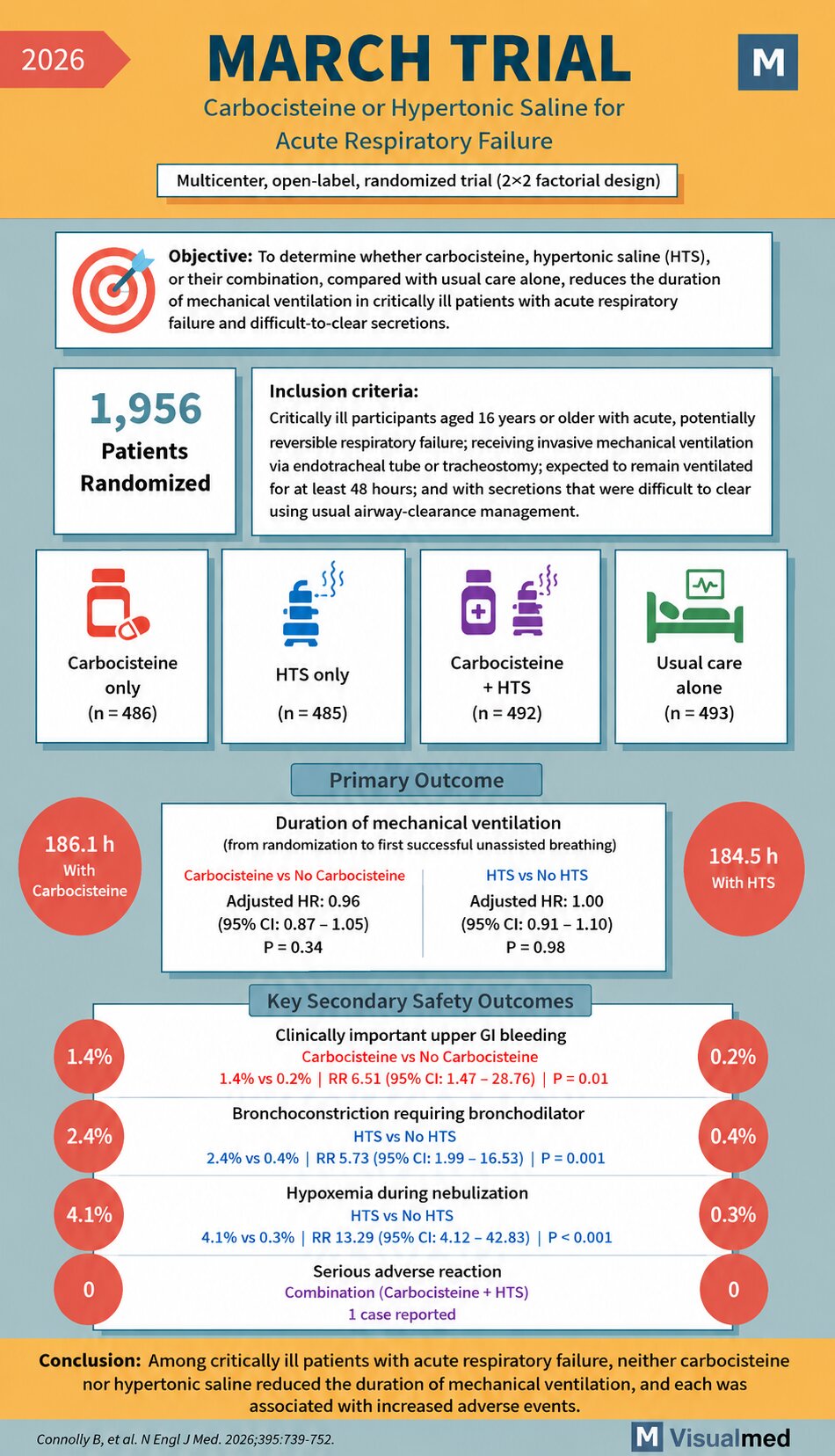
MARCH was a multicenter, open-label, randomized trial using a 2×2 factorial design.
A total of 1,956 critically ill patients were randomized.
Eligible patients were:
- At least 16 years old
- Experiencing acute and potentially reversible respiratory failure
- Receiving invasive mechanical ventilation through an endotracheal tube or tracheostomy
- Expected to remain ventilated for at least 48 hours
- Experiencing secretions that were difficult to clear using usual airway-clearance management
Participants were assigned to four groups:
- Carbocisteine alone: 486 patients
- Hypertonic saline alone: 485 patients
- Carbocisteine + hypertonic saline: 492 patients
- Usual care alone: 493 patients
Primary Outcome: No Reduction in Mechanical Ventilation
The primary endpoint was the duration of mechanical ventilation from randomization until the first successful period of unassisted breathing.
For carbocisteine versus no carbocisteine:
Adjusted hazard ratio: 0.96
95% CI: 0.87–1.05
P = 0.34
For hypertonic saline versus no hypertonic saline:
Adjusted hazard ratio: 1.00
95% CI: 0.91–1.10
P = 0.98
Neither intervention significantly accelerated liberation from mechanical ventilation.
The median duration of ventilation was approximately 186.1 hours among patients receiving carbocisteine and 184.5 hours among those receiving hypertonic saline, without evidence of meaningful clinical benefit.
Carbocisteine Increased Gastrointestinal Bleeding
The absence of efficacy was accompanied by important safety findings.
Clinically important upper gastrointestinal bleeding occurred in:
1.4% with carbocisteine vs 0.2% without carbocisteine
Relative risk: 6.51
95% CI: 1.47–28.76
P = 0.01
Although the absolute event rate was low, this represents a substantial relative increase.
Hypertonic Saline Increased Bronchoconstriction and Hypoxemia
Hypertonic saline was also associated with respiratory adverse effects.
Bronchoconstriction requiring bronchodilator treatment occurred in:
2.4% with hypertonic saline vs 0.4% without
RR: 5.73
95% CI: 1.99–16.53
P = 0.001
Hypoxemia during nebulization occurred in:
4.1% vs 0.3%
RR: 13.29
95% CI: 4.12–42.83
P < 0.001
A serious adverse reaction was also reported in a patient receiving the combination of carbocisteine and hypertonic saline.
What Does MARCH Mean for Clinical Practice?
MARCH provides little support for the routine use of carbocisteine or nebulized hypertonic saline solely to shorten mechanical ventilation in critically ill patients with difficult-to-clear secretions.
Both therapies are biologically plausible, and clinicians may observe transient changes in secretion characteristics after treatment. However, the trial demonstrates an important distinction between improving a physiologic surrogate and improving a meaningful patient outcome.
Neither intervention helped patients achieve successful unassisted breathing sooner.
Moreover, each treatment introduced additional safety concerns.
Bottom Line
The MARCH trial found that among critically ill patients with acute respiratory failure and difficult-to-clear secretions:
Carbocisteine did not shorten mechanical ventilation.
Hypertonic saline did not shorten mechanical ventilation.
Carbocisteine was associated with more clinically important gastrointestinal bleeding, while hypertonic saline increased bronchoconstriction and hypoxemia during nebulization.
The results argue against the routine use of either therapy for the purpose of accelerating liberation from mechanical ventilation.
Reference:
Connolly B, et al. N Engl J Med. 2026;395:739–752.