
For decades, intravenous fluids have been a cornerstone of early septic shock management. However, growing concern about fluid overload has led clinicians to question whether vasopressors should be started earlier, allowing patients to receive less intravenous fluid.
The ARISE FLUIDS trial, published in the New England Journal of Medicine in 2026, directly tested these two approaches in adults presenting to the emergency department with septic shock.
Why Was the ARISE FLUIDS Trial Needed?
Initial treatment of septic shock generally involves intravenous fluids to restore circulating volume, followed by vasopressors when hypotension persists.
The problem is that excessive fluid administration may contribute to tissue edema, respiratory deterioration, and other complications. An alternative strategy is to limit fluids and introduce vasopressors earlier to maintain perfusion.
ARISE FLUIDS asked a clinically important question:
Does a strategy of restricted intravenous fluids with earlier vasopressor therapy improve outcomes compared with giving more fluid and starting vasopressors later?
Study Design
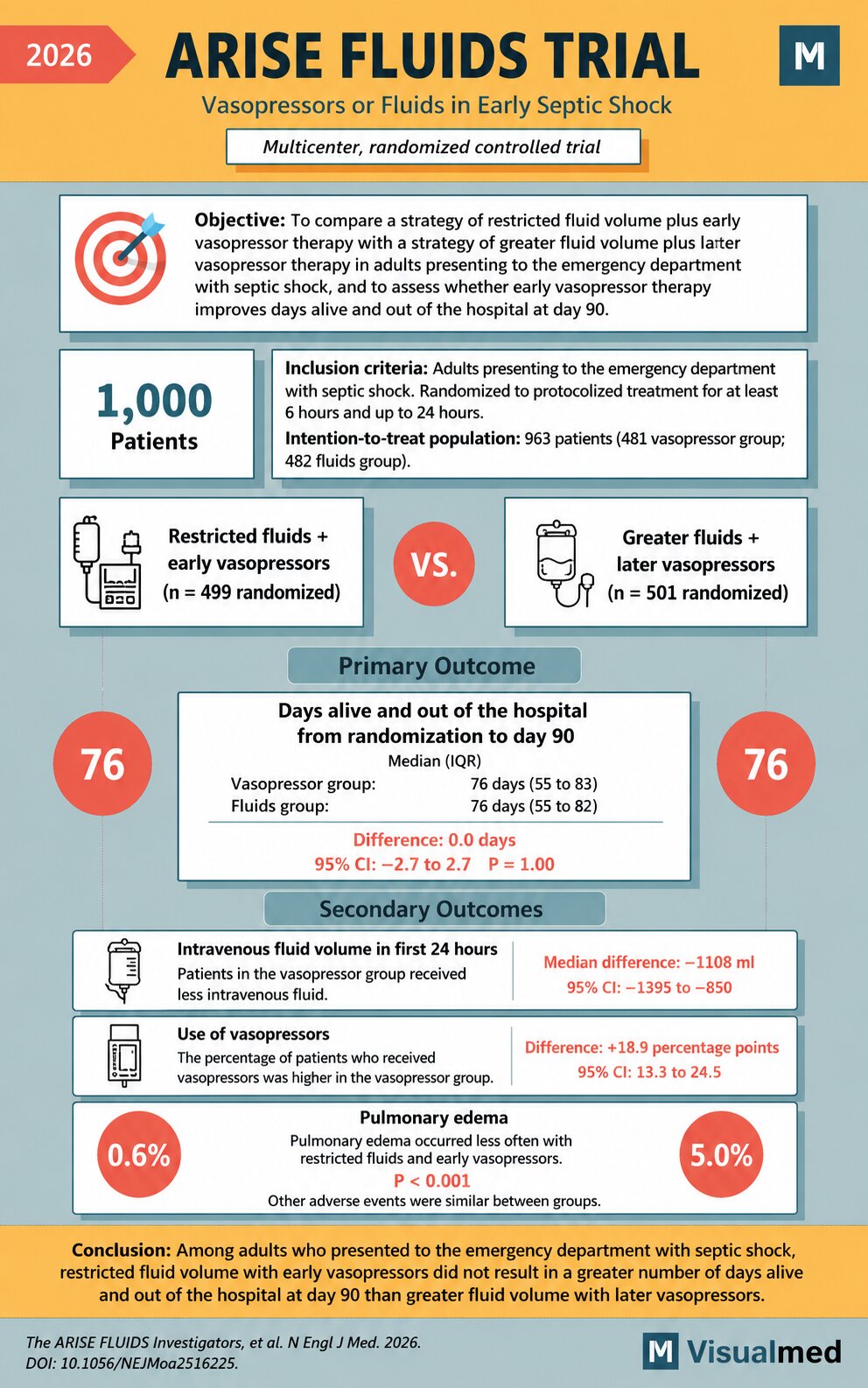
ARISE FLUIDS was a multicenter, randomized controlled trial involving 1,000 adults presenting to emergency departments with septic shock.
Patients were randomized to one of two treatment strategies:
- Restricted fluids + early vasopressors: 499 patients randomized
- Greater fluids + later vasopressors: 501 patients randomized
Protocolized treatment continued for at least 6 hours and for up to 24 hours.
The intention-to-treat analysis included 963 patients, with 481 in the early-vasopressor group and 482 in the greater-fluid group.
Primary Outcome: No Difference in Days Alive and Out of the Hospital
The primary outcome was the number of days alive and out of the hospital through day 90.
The results were essentially identical:
Restricted fluids + early vasopressors:
76 days (IQR 55–83)
Greater fluids + later vasopressors:
76 days (IQR 55–82)
Difference: 0.0 days
95% CI: −2.7 to 2.7
P = 1.00
Therefore, starting vasopressors earlier while restricting intravenous fluid administration did not increase the number of days patients were alive and outside the hospital at 90 days.
Early Vasopressors Substantially Reduced Fluid Administration
Although the primary clinical outcome was unchanged, the two treatment strategies produced clear differences in how patients were managed.
Patients assigned to the early-vasopressor strategy received substantially less intravenous fluid during the first 24 hours.
The median difference was:
−1,108 mL of intravenous fluid
95% CI: −1,395 to −850 mL
This demonstrates that an early vasopressor strategy can meaningfully reduce fluid exposure in patients with septic shock.
Vasopressor Use Increased
As expected, patients in the restricted-fluid strategy were more likely to receive vasopressors.
The difference in vasopressor use was:
+18.9 percentage points
95% CI: 13.3 to 24.5
In other words, clinicians were able to trade approximately one liter of additional fluid administration for earlier and more frequent use of vasopressors.
Pulmonary Edema Was Less Common
One of the most notable secondary findings involved pulmonary edema.
Pulmonary edema occurred in:
0.6% of patients receiving restricted fluids and early vasopressors
versus
5.0% of patients receiving greater fluids and later vasopressors
P < 0.001
Other adverse events were generally similar between the two groups.
This finding supports the physiologic concern that greater fluid administration can increase the risk of fluid-related pulmonary complications. However, secondary outcomes should be interpreted in the context of the trial’s overall neutral primary result.
What Does ARISE FLUIDS Mean for Clinical Practice?
ARISE FLUIDS provides an important message: less fluid is achievable, but it does not necessarily translate into better overall patient-centered outcomes.
An early vasopressor strategy reduced intravenous fluid exposure by more than one liter during the first 24 hours and was associated with substantially less pulmonary edema. Yet this did not improve the primary endpoint of days alive and out of the hospital at 90 days.
The trial therefore does not establish early vasopressors with fluid restriction as universally superior to a more fluid-forward approach.
Instead, the results support a more individualized approach to septic shock resuscitation. Patients who appear fluid responsive may still benefit from intravenous fluids, whereas patients at greater risk of congestion or fluid overload may be reasonable candidates for earlier vasopressor initiation.
Bottom Line
The ARISE FLUIDS trial found that, among adults presenting to the emergency department with septic shock, a strategy of restricted fluid administration with early vasopressors did not improve days alive and out of the hospital at 90 days compared with greater fluid administration and later vasopressor use.
However, early vasopressors reduced intravenous fluid administration by approximately 1.1 liters during the first 24 hours and were associated with a lower incidence of pulmonary edema.
The trial reinforces an evolving concept in septic shock management: the goal may not be simply “more fluid” or “less fluid,” but rather giving the right amount of fluid while initiating vasopressors at the appropriate time for the individual patient.
Reference:
The ARISE FLUIDS Investigators, the ANZICS Clinical Trials Group, and the ACEM Clinical Trials Network. Vasopressors or Fluids in Early Septic Shock. N Engl J Med. 2026. DOI: 10.1056/NEJMoa2516225.