
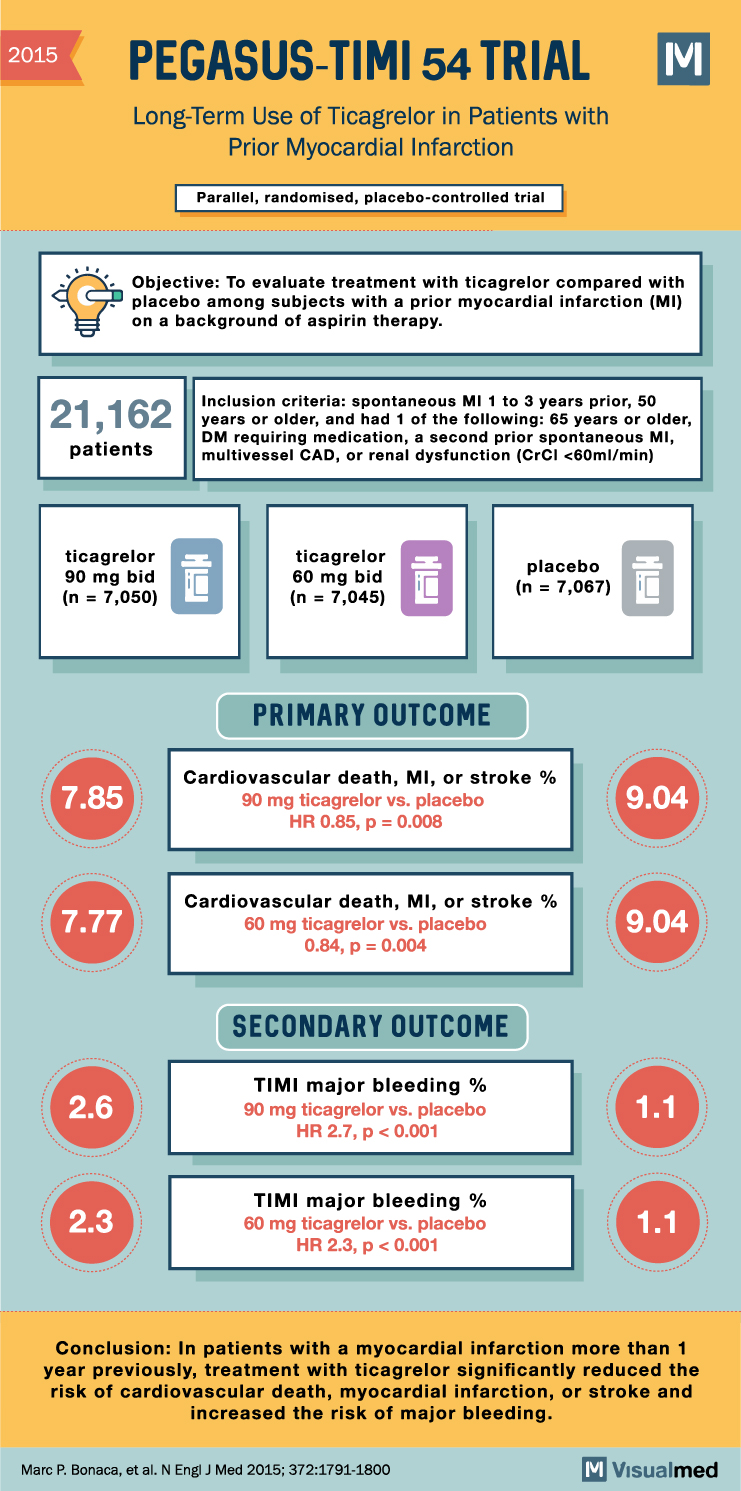
The PEGASUS-TIMI 54 trial was a major randomized clinical trial that evaluated whether long-term treatment with ticagrelor, added to aspirin, reduces cardiovascular events in patients with a prior myocardial infarction.
The key finding was straightforward: ticagrelor reduced cardiovascular death, myocardial infarction, or stroke, but increased major bleeding.
Background
Patients who have had a myocardial infarction remain at increased risk for future cardiovascular events even after the first year. Standard therapy often includes aspirin, statins, blood pressure control, and lifestyle modification, but residual ischemic risk remains high in selected patients.
The clinical question in PEGASUS-TIMI 54 was whether prolonged P2Y12 inhibition with ticagrelor could provide additional protection in stable patients with a prior MI.
Objective of the PEGASUS-TIMI 54 Trial
The objective was to evaluate treatment with ticagrelor compared with placebo in patients with a prior myocardial infarction who were already receiving background aspirin therapy.
Study Design
PEGASUS-TIMI 54 was a:
Parallel, randomized, placebo-controlled trial
The trial included 21,162 patients.
Patients had a spontaneous MI 1 to 3 years prior and were at least 50 years old.
They also had at least one additional high-risk feature, such as:
- Age 65 years or older
- Diabetes requiring medication
- Second prior spontaneous MI
- Multivessel coronary artery disease
- Renal dysfunction with CrCl less than 60 mL/min
Patients were randomized to one of three groups:
- Ticagrelor 90 mg twice daily
n = 7,050 - Ticagrelor 60 mg twice daily
n = 7,045 - Placebo
n = 7,067
All groups received background aspirin therapy.
Primary Outcome
The primary outcome was:
Cardiovascular death, myocardial infarction, or stroke
Ticagrelor 90 mg twice daily vs placebo
Ticagrelor 90 mg: 7.85%
Placebo: 9.04%
Risk reduction:
HR 0.85; P = 0.008
Ticagrelor 60 mg twice daily vs placebo
Ticagrelor 60 mg: 7.77%
Placebo: 9.04%
Risk reduction:
HR 0.84; P = 0.004
Both ticagrelor doses significantly reduced the risk of cardiovascular death, MI, or stroke compared with placebo.
Secondary Outcome: Major Bleeding
The major safety outcome was:
TIMI major bleeding
Ticagrelor 90 mg twice daily vs placebo
Ticagrelor 90 mg: 2.6%
Placebo: 1.1%
Risk increase:
HR 2.7; P < 0.001
Ticagrelor 60 mg twice daily vs placebo
Ticagrelor 60 mg: 2.3%
Placebo: 1.1%
Risk increase:
HR 2.3; P < 0.001
So while ticagrelor reduced ischemic events, it also clearly increased major bleeding.
Why PEGASUS-TIMI 54 Matters
The PEGASUS-TIMI 54 trial helped define the role of extended antiplatelet therapy in stable patients with prior MI.
The trial showed that selected high-risk patients may benefit from continuing intensified antiplatelet therapy beyond the first year after MI. However, the benefit must be balanced against bleeding risk.
This is not a “treat everyone forever” message. It is a patient-selection trial.
The patients most likely to benefit are those with high ischemic risk and acceptable bleeding risk.
Clinical Takeaway
The main takeaway from PEGASUS-TIMI 54 is:
In patients with MI more than 1 year prior, ticagrelor added to aspirin reduced cardiovascular death, myocardial infarction, or stroke, but increased TIMI major bleeding.
The 60 mg twice-daily dose became especially clinically relevant because it provided similar ischemic benefit with slightly less major bleeding compared with the 90 mg dose.
Practical Interpretation
Long-term ticagrelor may be considered in patients with prior MI who have high-risk features such as:
- Diabetes
- Multivessel coronary artery disease
- Recurrent prior MI
- Chronic kidney disease
- Older age
- Low bleeding risk
It should be avoided or used cautiously in patients with:
- Prior major bleeding
- High bleeding risk
- Need for chronic anticoagulation
- Severe anemia
- Poor tolerance of antiplatelet therapy
- Frequent falls or frailty
Conclusion
The PEGASUS-TIMI 54 trial demonstrated that in patients with a myocardial infarction more than one year earlier, long-term ticagrelor therapy on top of aspirin significantly reduced the risk of cardiovascular death, myocardial infarction, or stroke.
However, this benefit came with a significant increase in TIMI major bleeding.
In simple terms: extended ticagrelor lowers ischemic risk after prior MI, but you pay for that benefit with more bleeding — so careful patient selection is essential.