
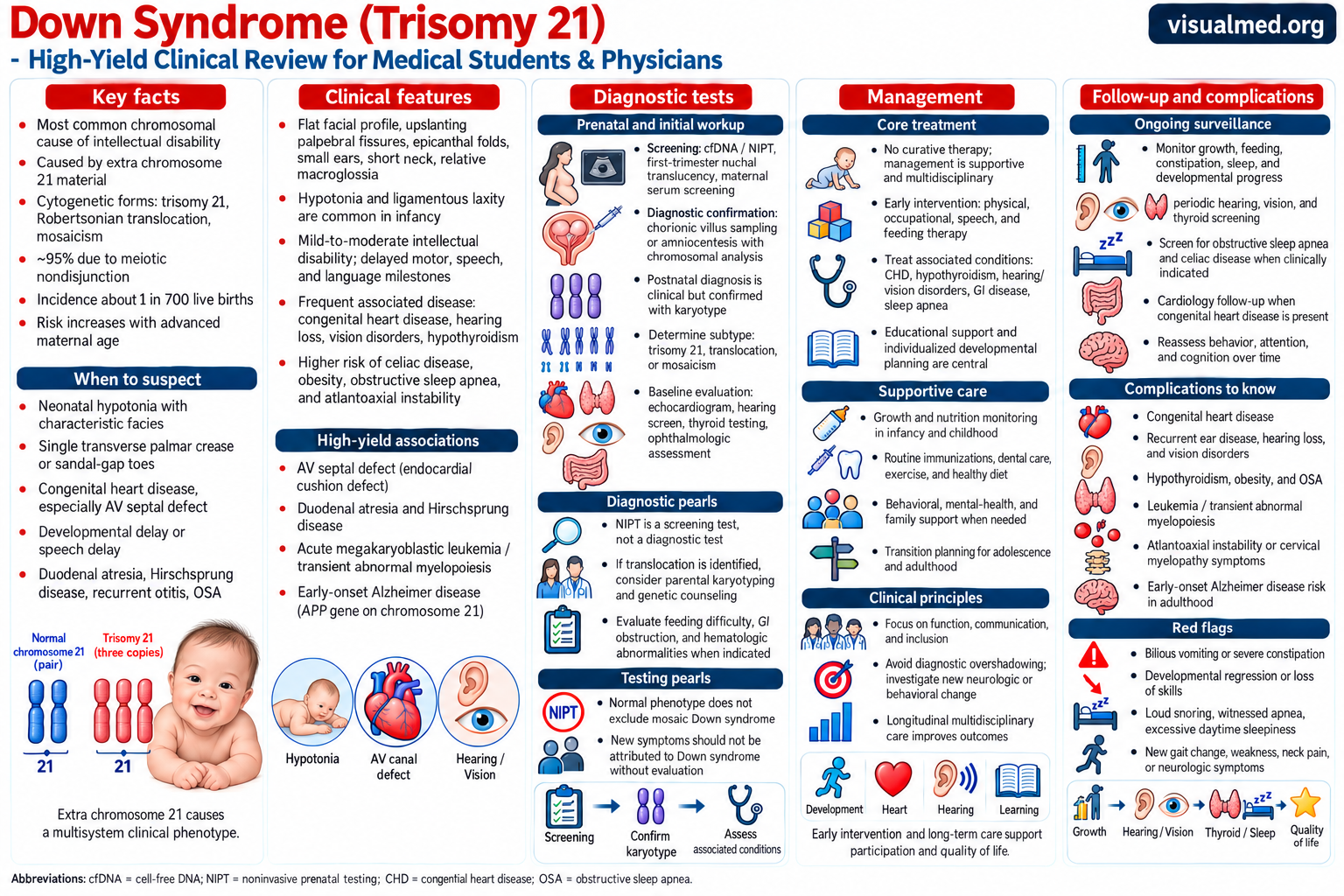
Down syndrome, or trisomy 21, is the most common chromosomal disorder associated with intellectual disability. It results from the presence of additional genetic material from chromosome 21 and produces a characteristic constellation of developmental, cardiovascular, gastrointestinal, endocrine, hematologic, neurologic, and musculoskeletal findings.
For medical students and physicians, the key is not simply recognizing the phenotype. Down syndrome should prompt a systematic search for associated congenital and acquired conditions, particularly congenital heart disease, thyroid dysfunction, hearing and vision abnormalities, obstructive sleep apnea, gastrointestinal disease, and hematologic abnormalities.
Genetics of Down Syndrome
Down syndrome occurs because of extra chromosome 21 material.
Three major cytogenetic patterns are recognized.
Trisomy 21
Approximately 95% of cases result from meiotic nondisjunction, producing three complete copies of chromosome 21.
The risk increases with advancing maternal age, although most affected infants are born to younger mothers because the overall number of pregnancies is greater in that population.
Robertsonian Translocation
A smaller proportion of patients have additional chromosome 21 material attached to another chromosome, commonly chromosome 14 or 21.
This distinction matters because a parent may carry a balanced Robertsonian translocation, significantly affecting recurrence risk.
Parental karyotyping and genetic counseling should therefore be considered when translocation Down syndrome is identified.
Mosaic Down Syndrome
Mosaicism results from postzygotic nondisjunction, producing two or more cell lines.
Some cells have a normal chromosome complement, while others demonstrate trisomy 21.
Clinical manifestations may be less pronounced, but phenotype does not reliably predict the degree of mosaicism.
Characteristic Clinical Features
Recognition is usually clinical at birth, followed by chromosomal confirmation.
Common physical findings include:
- Hypotonia
- Flat facial profile
- Upslanting palpebral fissures
- Epicanthal folds
- Small or low-set ears
- Short neck
- Relative macroglossia or protruding tongue
- Single transverse palmar crease
- Short broad hands
- Fifth-finger clinodactyly
- Increased space between the first and second toes, or sandal gap
- Ligamentous laxity
Developmental delay is common, particularly involving motor and speech milestones.
Intellectual disability is typically mild to moderate, although functional ability varies widely between individuals.
Congenital Heart Disease in Down Syndrome
Congenital heart disease occurs in approximately 40–50% of children with Down syndrome.
The classic association is an atrioventricular septal defect, particularly a complete AV canal defect.
Other congenital cardiac lesions include:
- Ventricular septal defect
- Atrial septal defect
- Patent ductus arteriosus
- Tetralogy of Fallot
Because congenital heart disease is so common, all newborns with Down syndrome should undergo cardiac evaluation, typically including echocardiography.
High-Yield Association
Down syndrome + endocardial cushion defect = atrioventricular septal defect.
This is a classic board examination association and reflects abnormal development of the endocardial cushions.
Gastrointestinal Associations
Several congenital gastrointestinal abnormalities are strongly associated with trisomy 21.
Important conditions include:
Duodenal Atresia
Down syndrome has a classic association with duodenal atresia.
Affected neonates may present with:
- Bilious vomiting
- Feeding intolerance
- Abdominal distension
Abdominal radiography may demonstrate the classic double-bubble sign.
Hirschsprung Disease
Hirschsprung disease occurs more frequently in patients with Down syndrome.
Consider it in infants with:
- Delayed passage of meconium
- Severe constipation
- Abdominal distension
- Enterocolitis
Celiac Disease
Patients with Down syndrome also have an increased risk of celiac disease.
Screening should be considered when compatible symptoms develop, including chronic diarrhea, constipation, abdominal discomfort, poor growth, or unexplained iron deficiency.
Endocrine Disorders
Hypothyroidism
Thyroid dysfunction is among the most important long-term medical associations.
Both congenital and acquired hypothyroidism occur more frequently in patients with Down syndrome.
Thyroid function should therefore be monitored periodically throughout life.
Physicians should maintain a low threshold for reassessment when patients develop:
- Fatigue
- Constipation
- Weight gain
- Poor growth
- Developmental slowing
- Changes in behavior or school performance
These symptoms should not automatically be attributed to Down syndrome itself.
Hearing and Vision Abnormalities
Hearing loss is common and may result from:
- Chronic otitis media
- Conductive hearing loss
- Sensorineural hearing loss
Because hearing impairment can significantly worsen speech and developmental delay, routine audiologic surveillance is important.
Ophthalmologic abnormalities may include:
- Refractive errors
- Strabismus
- Nystagmus
- Cataracts
- Keratoconus
Regular ophthalmologic evaluation is therefore recommended.
Obstructive Sleep Apnea
Children and adults with Down syndrome have a markedly increased risk of obstructive sleep apnea.
Contributing factors include:
- Midface hypoplasia
- Relative macroglossia
- Adenotonsillar hypertrophy
- Hypotonia
- Obesity
Symptoms may include loud snoring, witnessed apneas, restless sleep, daytime somnolence, behavioral change, or declining school performance.
Importantly, clinical symptoms alone may underestimate the severity of sleep-disordered breathing.
Hematologic Disorders
Down syndrome is associated with several characteristic hematologic abnormalities.
Transient Abnormal Myelopoiesis
Some neonates with Down syndrome develop transient abnormal myelopoiesis, also called transient myeloproliferative disorder.
It is strongly associated with mutations involving GATA1.
Although it can resolve spontaneously, affected infants require follow-up because of the subsequent risk of acute leukemia.
Acute Leukemia
Children with Down syndrome have an increased risk of:
- Acute megakaryoblastic leukemia
- Acute lymphoblastic leukemia
Acute megakaryoblastic leukemia is a particularly high-yield association with Down syndrome.
Atlantoaxial Instability
Ligamentous laxity can produce excessive movement between the atlas and axis.
Most patients are asymptomatic.
Symptoms concerning for cervical cord compression include:
- Neck pain
- Gait abnormalities
- Weakness
- Hyperreflexia
- Loss of coordination
- Bowel or bladder dysfunction
New neurologic symptoms require prompt evaluation.
Routine cervical spine radiographs in asymptomatic patients are no longer universally recommended solely for screening; clinical symptoms should guide evaluation.
Neurologic Disease and Alzheimer Disease
Patients with Down syndrome have an increased risk of developing early-onset Alzheimer disease.
One important molecular connection is the amyloid precursor protein (APP) gene, located on chromosome 21.
An additional copy of chromosome 21 increases APP expression and contributes to amyloid-beta accumulation.
Neuropathologic changes associated with Alzheimer disease may develop decades before clinical dementia becomes apparent.
Clinicians should evaluate new cognitive or functional decline carefully rather than automatically assuming dementia.
Potential mimics include:
- Depression
- Hypothyroidism
- Hearing impairment
- Sleep apnea
- Medication effects
- Other neurologic disease
Prenatal Screening for Down Syndrome
Prenatal testing can be divided into screening and diagnostic testing.
This distinction is important.
Cell-Free DNA Testing
Cell-free fetal DNA testing, commonly called cfDNA or NIPT, is a highly sensitive screening test for trisomy 21.
However:
NIPT is a screening test, not a diagnostic test.
A positive result should be confirmed with diagnostic testing before irreversible clinical decisions are made.
First-Trimester Screening
First-trimester screening may combine:
- Nuchal translucency ultrasound
- Pregnancy-associated plasma protein A
- β-hCG
Increased nuchal translucency raises concern for chromosomal abnormalities as well as congenital heart disease.
Diagnostic Testing
Definitive prenatal diagnosis requires fetal chromosomal analysis obtained through:
- Chorionic villus sampling
- Amniocentesis
Postnatal Diagnosis
Following delivery, Down syndrome may be suspected clinically.
The diagnosis should be confirmed with karyotype analysis.
Karyotyping is important not simply for confirmation, but also for determining whether the patient has:
- Standard trisomy 21
- Translocation
- Mosaicism
Identification of a translocation may change counseling regarding recurrence risk.
Initial Evaluation After Diagnosis
A newborn diagnosed with Down syndrome requires a structured evaluation for associated disease.
Important components include:
- Complete physical examination
- Echocardiography
- Hearing assessment
- Thyroid testing
- Feeding assessment
- Evaluation for gastrointestinal obstruction
- Ophthalmologic surveillance
- Hematologic assessment
- Developmental evaluation
The key clinical principle is that Down syndrome is a multisystem diagnosis.
Do not stop after establishing the karyotype.
Management of Down Syndrome
There is no therapy that reverses trisomy 21 itself.
Management focuses on maximizing health, development, communication, function, and independence while treating associated diseases.
Early Intervention
Early developmental therapy should begin as soon as appropriate.
Interventions commonly include:
- Physical therapy
- Occupational therapy
- Speech and language therapy
- Feeding therapy
- Educational support
Hypotonia can delay gross motor development, while hearing abnormalities may compound speech and language delay.
Correcting treatable contributors can significantly improve functional outcomes.
Long-Term Surveillance
Down syndrome requires longitudinal surveillance throughout childhood and adulthood.
Important areas include:
- Growth
- Nutrition
- Thyroid function
- Hearing
- Vision
- Dental care
- Sleep apnea
- Development and learning
- Behavioral and psychiatric health
- Congenital heart disease
- Celiac disease
- Obesity
- Neurologic function
Clinicians should avoid diagnostic overshadowing—the tendency to attribute new symptoms to the underlying intellectual disability or genetic syndrome.
A new change in behavior, function, gait, sleep, appetite, or cognition should prompt an appropriate differential diagnosis.
High-Yield Down Syndrome Associations
For medical students preparing for exams, several associations are particularly important:
| Finding | Association with Down Syndrome |
|---|---|
| Chromosome abnormality | Trisomy 21 |
| Most common mechanism | Meiotic nondisjunction |
| Maternal risk factor | Advanced maternal age |
| Classic cardiac lesion | AV septal defect |
| GI abnormality | Duodenal atresia |
| Other GI association | Hirschsprung disease |
| Endocrine disorder | Hypothyroidism |
| Sleep disorder | Obstructive sleep apnea |
| Childhood malignancy | Acute megakaryoblastic leukemia |
| Musculoskeletal issue | Atlantoaxial instability |
| Adult neurologic disease | Early-onset Alzheimer disease |
| Alzheimer-related gene | APP on chromosome 21 |
| Screening test | cfDNA / NIPT |
| Definitive diagnosis | Karyotype |
Clinical Pearls
1. A positive NIPT does not establish the diagnosis.
Confirm with CVS or amniocentesis when prenatal definitive diagnosis is required.
2. Always look for congenital heart disease.
Approximately half of affected children have a congenital cardiac defect.
3. Think AV canal defect when Down syndrome appears in a cardiac question.
4. Bilious vomiting in a newborn with Down syndrome should raise concern for duodenal atresia.
5. Severe constipation or delayed meconium passage should raise concern for Hirschsprung disease.
6. Developmental decline is not simply “part of Down syndrome.”
Consider thyroid disease, hearing loss, sleep apnea, depression, neurologic disease, and other treatable conditions.
7. Translocation Down syndrome changes the genetic counseling discussion.
Consider parental karyotyping.
Bottom Line
Down syndrome is a multisystem chromosomal disorder caused by additional chromosome 21 material.
For clinicians, the diagnosis should immediately trigger assessment for associated disease, particularly:
Heart disease → GI abnormalities → thyroid dysfunction → hearing and vision impairment → sleep apnea → hematologic disease → developmental needs.
The core management strategy is early intervention plus lifelong surveillance.
Recognition of treatable associated conditions is one of the most important ways physicians can improve health, development, and long-term quality of life for patients with Down syndrome.
VisualMed Clinical Summary
The VisualMed Down Syndrome Clinical Cheat Sheet provides a rapid visual review of:
Genetics → Clinical Features → Diagnostic Testing → Treatment → Long-Term Surveillance
Use it for medical school review, board preparation, clinical rotations, and point-of-care reference.
Explore more visual medical summaries, clinical concepts, and landmark trials at VisualMed.org and in the VisualMed app.