
Introduction
The EXCEL trial was a major randomized clinical trial comparing percutaneous coronary intervention (PCI) with coronary artery bypass grafting (CABG) in patients with left main coronary artery disease.
Left main disease is one of the most important forms of coronary artery disease because the left main artery supplies a large portion of the heart muscle. Traditionally, CABG has been considered the standard treatment for many patients with significant left main disease. However, with improvements in stent technology, PCI became a potential alternative in selected patients.
The EXCEL trial was designed to evaluate whether PCI using contemporary drug-eluting stents could provide similar long-term outcomes compared with CABG.
Study Design
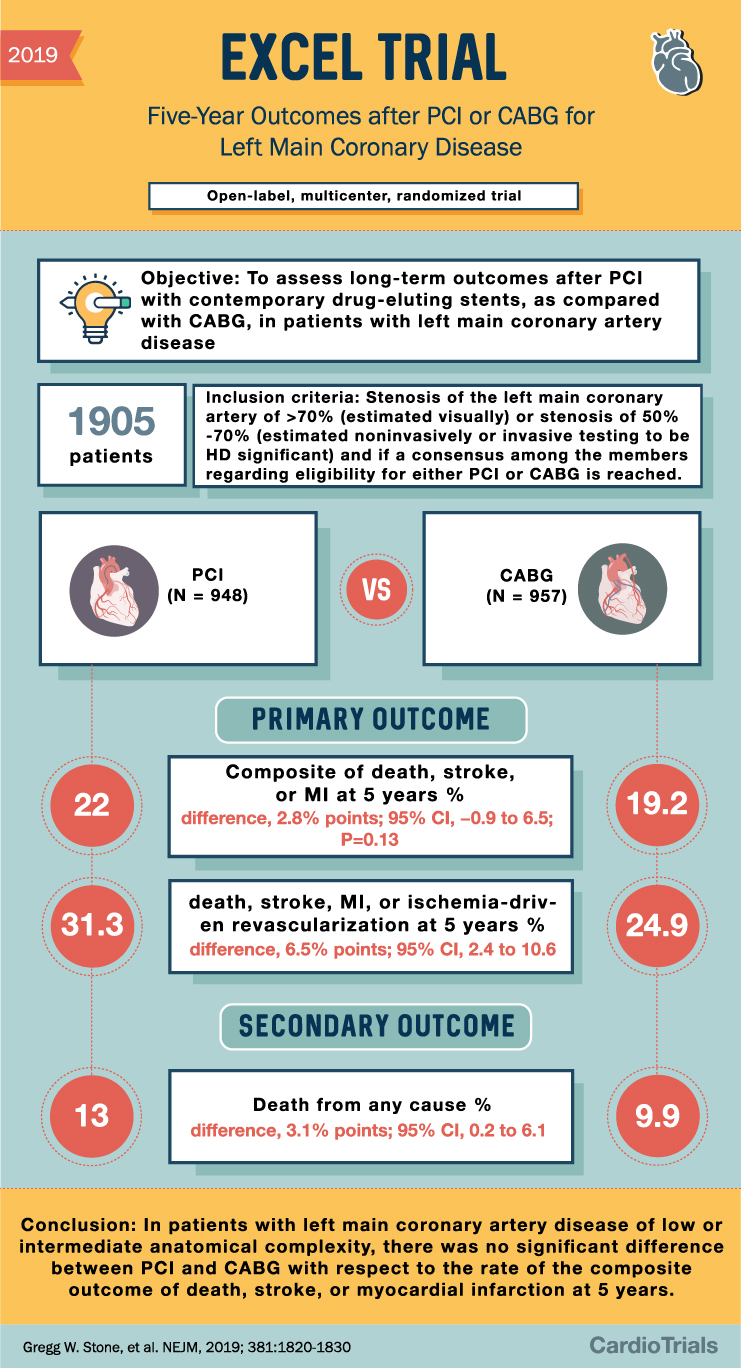
The EXCEL trial was an open-label, multicenter, randomized trial.
A total of 1,905 patients with left main coronary artery disease were enrolled.
Patients were randomized to:
PCI group: 948 patients
CABG group: 957 patients
The trial focused on patients with left main coronary artery disease of low or intermediate anatomic complexity, meaning these were patients whose coronary anatomy was considered suitable for either PCI or CABG.
Inclusion Criteria
Patients were included if they had significant left main coronary artery disease, defined as:
Stenosis of the left main coronary artery of greater than 70%, estimated visually, or stenosis of 50% to 70% if determined to be hemodynamically significant by noninvasive or invasive testing.
Patients also had to be considered eligible for either PCI or CABG by the treating heart team.
Primary Outcome
The main outcome was a composite of:
death, stroke, or myocardial infarction at 5 years.
At 5 years, the primary outcome occurred in:
22.0% of patients in the PCI group
19.2% of patients in the CABG group
The difference was 2.8 percentage points, with a 95% confidence interval of -0.9 to 6.5, and a P value of 0.13.
This means there was no statistically significant difference between PCI and CABG for the composite outcome of death, stroke, or myocardial infarction at 5 years.
Additional Outcome
Another important composite outcome included:
death, stroke, myocardial infarction, or ischemia-driven revascularization at 5 years.
This occurred in:
31.3% of patients in the PCI group
24.9% of patients in the CABG group
The difference was 6.5 percentage points, with a 95% confidence interval of 2.4 to 10.6.
This favored CABG, largely because patients treated with PCI were more likely to require repeat revascularization.
Secondary Outcome
Death from any cause occurred in:
13.0% of patients in the PCI group
9.9% of patients in the CABG group
The difference was 3.1 percentage points, with a 95% confidence interval of 0.2 to 6.1.
This finding raised important discussion around longer-term outcomes after PCI versus CABG in left main coronary artery disease.
Main Findings of the EXCEL Trial
The EXCEL trial showed that, among selected patients with left main coronary artery disease and low or intermediate anatomic complexity, PCI and CABG had no statistically significant difference in the composite outcome of death, stroke, or myocardial infarction at 5 years.
However, broader outcomes including ischemia-driven revascularization favored CABG, and all-cause mortality was numerically higher in the PCI group.
In practical terms, PCI may be a reasonable option for carefully selected patients with left main disease, especially when anatomy is favorable and surgical risk is high. CABG remains a strong option, particularly when durability and avoidance of repeat procedures are major priorities.
Clinical Importance
The EXCEL trial is important because it helped shape the modern heart-team discussion for left main coronary artery disease.
Instead of treating all left main disease the same way, the trial emphasized the importance of:
coronary anatomy,
SYNTAX score,
surgical risk,
patient preference,
likelihood of complete revascularization,
and long-term durability.
For patients with complex coronary disease, CABG may still offer a more durable strategy. For selected patients with less complex left main disease, PCI can be considered as an alternative.
Practical Takeaway
The EXCEL trial supports the idea that PCI can be considered in selected patients with left main coronary artery disease of low or intermediate anatomic complexity.
At 5 years, PCI and CABG did not significantly differ for the composite outcome of death, stroke, or myocardial infarction. However, CABG was associated with fewer ischemia-driven repeat procedures, and the mortality signal requires careful interpretation during shared decision-making.
Reference
Stone GW, et al. Five-Year Outcomes after PCI or CABG for Left Main Coronary Disease. New England Journal of Medicine. 2019;381:1820-1830.