
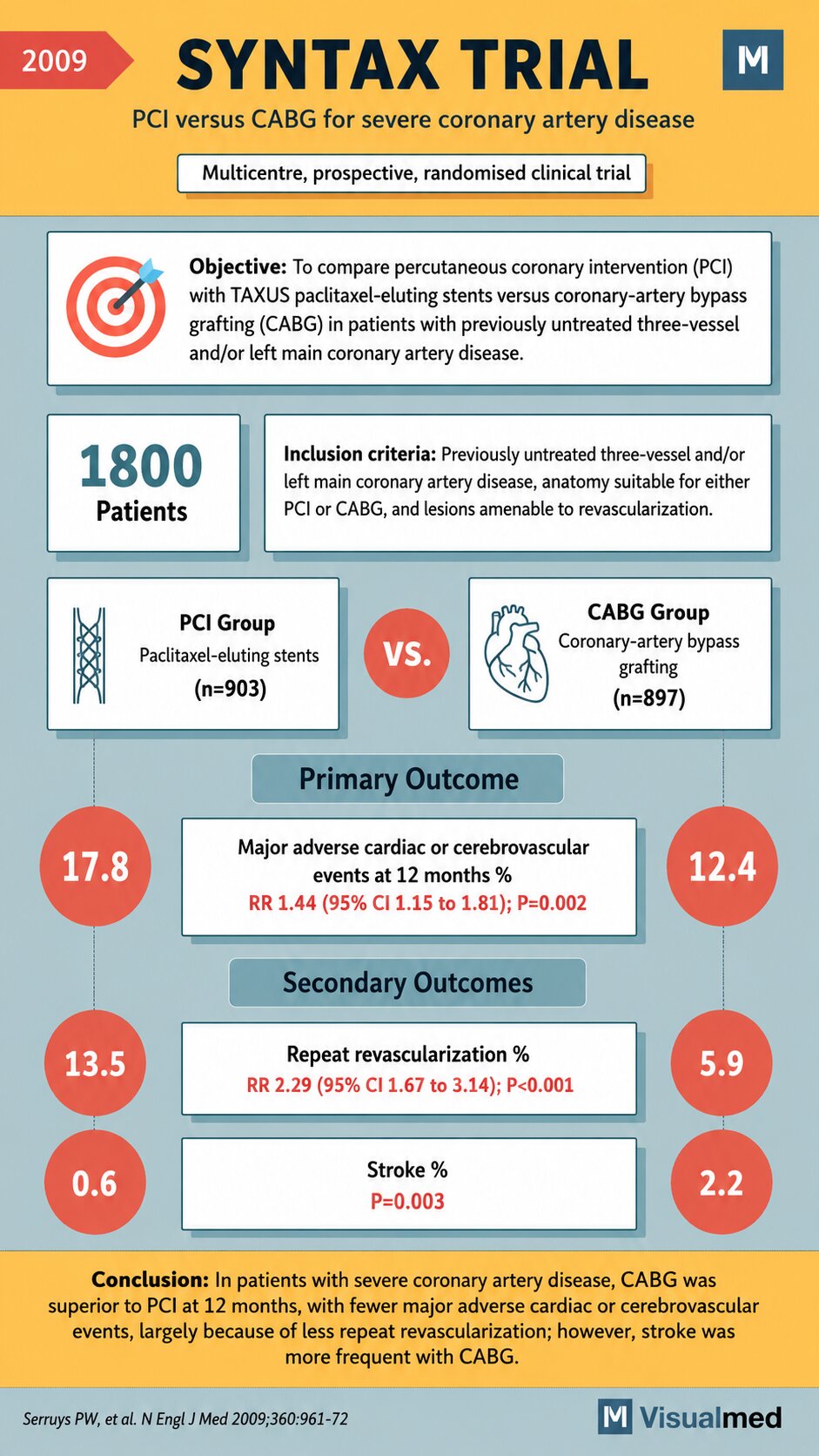
The SYNTAX trial was a landmark randomized controlled trial comparing percutaneous coronary intervention (PCI) with coronary artery bypass grafting (CABG) in patients with complex coronary artery disease, specifically those with three-vessel disease and/or left main coronary artery disease.
This trial helped shape modern decision-making for patients with severe coronary artery disease and remains one of the most important studies in interventional cardiology and cardiac surgery.
Background
For patients with advanced coronary artery disease, two major revascularization strategies are available:
PCI, commonly known as coronary stenting, is less invasive and involves opening blocked arteries using balloons and stents.
CABG, or bypass surgery, is more invasive but can provide more complete revascularization, especially in patients with complex multivessel disease.
Before the SYNTAX trial, there was ongoing debate about whether PCI could safely replace CABG in patients with severe coronary artery disease. The trial was designed to directly compare these two approaches.
Study Design
The SYNTAX trial was a multicenter, parallel-group, randomized controlled trial.
A total of 1,800 patients with three-vessel and/or left main coronary artery disease were randomized to undergo either PCI or CABG.
Patients were assigned to:
PCI with paclitaxel-eluting stents: 903 patients
CABG: 897 patients
The main objective was to compare PCI and CABG in terms of major cardiovascular events.
Primary Outcome
The primary outcome was the rate of major cardiovascular events at 1 year. This included:
death, stroke, myocardial infarction, or repeat revascularization.
At 1 year, major cardiovascular events occurred in:
17.8% of patients in the PCI group
12.4% of patients in the CABG group
This difference favored CABG.
The relative risk was 1.44, with a 95% confidence interval of 1.15 to 1.81, and a P value of 0.002.
Secondary Outcome
A key driver of the difference between the two groups was the need for repeat revascularization.
Repeat revascularization occurred more often in the PCI group:
54.8% in the PCI group
48.5% in the CABG group
The reported relative risk was 2.29, with a 95% confidence interval of 1.67 to 3.14, and a P value <0.001.
Main Findings
The SYNTAX trial showed that, among patients with severe coronary artery disease involving three-vessel and/or left main disease, CABG resulted in fewer major cardiovascular events at 1 year compared with PCI.
The main reason PCI performed worse was the higher need for repeat revascularization. In simple terms, patients treated with stents were more likely to need another procedure later.
Clinical Importance
The SYNTAX trial changed how cardiologists and surgeons think about complex coronary artery disease.
For patients with less complex anatomy, PCI may still be a reasonable option. However, for patients with more complex three-vessel disease or left main disease, especially when the coronary anatomy is extensive or diffuse, CABG often provides better long-term protection from repeat events.
The trial also led to broader use of the SYNTAX score, an angiographic scoring system used to estimate the complexity of coronary artery disease and help guide whether PCI or CABG is the better option.
Practical Takeaway
The SYNTAX trial supports CABG as the preferred revascularization strategy for many patients with complex three-vessel and/or left main coronary artery disease.
PCI remains an important treatment option, but in complex coronary anatomy, the risk of repeat procedures and major cardiovascular events is higher compared with CABG.
Reference
Serruys PW, et al. Percutaneous Coronary Intervention versus Coronary-Artery Bypass Grafting for Severe Coronary Artery Disease. New England Journal of Medicine. 2009;360:961-972.