
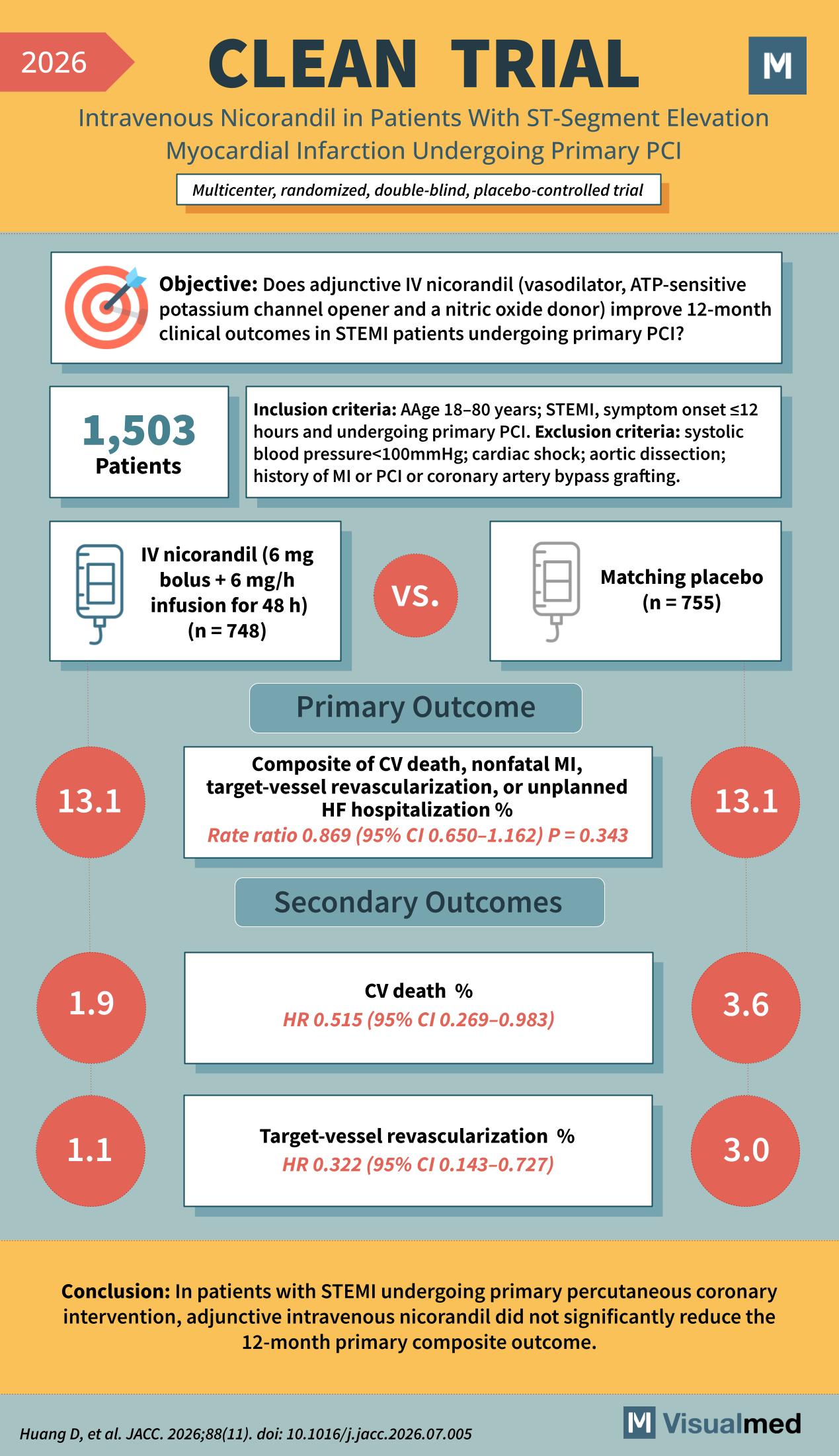
Does intravenous nicorandil improve cardiovascular outcomes after primary PCI in patients with ST-elevation myocardial infarction? The CLEAN trial investigated whether adjunctive nicorandil could reduce cardiovascular death, recurrent myocardial infarction, repeat revascularization, and heart failure hospitalization.
Background: Nicorandil and Myocardial Reperfusion Injury
Primary percutaneous coronary intervention (PCI) remains the standard reperfusion strategy for patients presenting with ST-segment elevation myocardial infarction (STEMI). Although timely restoration of epicardial coronary blood flow significantly improves survival, microvascular dysfunction and ischemia-reperfusion injury continue to contribute to adverse cardiovascular outcomes.
Nicorandil is a vasodilator with a dual mechanism of action:
- ATP-sensitive potassium channel activation: May provide cardioprotective effects by reducing cellular injury associated with ischemia and reperfusion.
- Nitric oxide donation: Promotes vascular smooth muscle relaxation and coronary vasodilation, potentially improving myocardial perfusion.
Previous investigations suggested that nicorandil might improve coronary microvascular function and limit myocardial injury. However, whether these physiological benefits translate into improved long-term clinical outcomes remained uncertain.
The CLEAN trial (2026) was designed to evaluate the clinical efficacy of intravenous nicorandil in patients undergoing primary PCI for STEMI.
CLEAN Trial: Study Design
The CLEAN trial was a multicenter, randomized, double-blind, placebo-controlled study evaluating adjunctive intravenous nicorandil in patients with STEMI undergoing primary PCI.
A total of 1,503 patients were randomized into two treatment groups.
| Study characteristic | Details |
|---|---|
| Trial | CLEAN |
| Publication | JACC, 2026 |
| Design | Multicenter, randomized, double-blind, placebo-controlled |
| Population | STEMI undergoing primary PCI |
| Sample size | 1,503 patients |
| Intervention | IV nicorandil (n = 748) |
| Comparator | Matching placebo (n = 755) |
| Follow-up | 12 months |
| Primary endpoint | CV death, nonfatal MI, target-vessel revascularization, or unplanned HF hospitalization |
Inclusion Criteria
Patients were eligible if they met the following criteria:
- Age 18–80 years
- Diagnosis of STEMI
- Symptom onset within 12 hours
- Undergoing primary PCI
Exclusion Criteria
Major exclusion criteria included:
- Systolic blood pressure below 100 mmHg
- Cardiogenic shock
- Aortic dissection
- Previous myocardial infarction
- Previous PCI or coronary artery bypass grafting
Treatment Protocol
Patients randomized to the intervention group received:
Intravenous nicorandil:
- Initial bolus: 6 mg
- Continuous infusion: 6 mg/hour
- Infusion duration: 48 hours
- Total patients: 748
Control group:
- Matching placebo
- Total patients: 755
The study evaluated whether early intravenous nicorandil administration could improve clinical outcomes over the subsequent 12 months.
CLEAN Trial Results
Primary Outcome: No Significant Reduction in Major Cardiovascular Events
The primary endpoint was a composite of:
- Cardiovascular death
- Nonfatal myocardial infarction
- Target-vessel revascularization
- Unplanned hospitalization for heart failure
At 12 months, the primary composite outcome occurred in:
| Outcome | IV nicorandil | Placebo |
|---|---|---|
| Primary composite endpoint | 13.1% | 13.1% |
Rate ratio: 0.869 (95% CI 0.650–1.162); P = 0.343
There was no statistically significant difference in the primary composite endpoint between the nicorandil and placebo groups.
These findings indicate that adjunctive intravenous nicorandil did not demonstrate an overall clinical benefit for the prespecified primary endpoint in STEMI patients undergoing primary PCI.
Secondary Outcome: Cardiovascular Death
Despite the neutral primary outcome, cardiovascular mortality was lower in the nicorandil group.
| Outcome | IV nicorandil | Placebo |
|---|---|---|
| Cardiovascular death | 1.9% | 3.6% |
Hazard ratio: 0.515 (95% CI 0.269–0.983)
This represents an approximately 48.5% relative reduction in the hazard of cardiovascular death.
Although this finding suggests a potentially important benefit, it must be interpreted cautiously because the primary outcome was not statistically significant.
Secondary endpoint findings can be hypothesis-generating, particularly when multiple outcomes are evaluated.
Secondary Outcome: Target-Vessel Revascularization
The trial also demonstrated a lower rate of target-vessel revascularization among patients receiving intravenous nicorandil.
| Outcome | IV nicorandil | Placebo |
|---|---|---|
| Target-vessel revascularization | 1.1% | 3.0% |
Hazard ratio: 0.322 (95% CI 0.143–0.727)
This corresponds to an approximately 67.8% relative reduction in the hazard of target-vessel revascularization.
While encouraging, this secondary outcome should also be considered exploratory in the setting of a neutral primary endpoint.
Clinical Interpretation: What Does the CLEAN Trial Mean?
The CLEAN trial provides important evidence regarding the role of intravenous nicorandil during primary PCI.
1. Nicorandil did not improve the primary composite endpoint.
Despite its theoretically favorable effects on myocardial microvascular circulation and ischemia-reperfusion injury, intravenous nicorandil did not significantly reduce the combined incidence of cardiovascular death, nonfatal MI, target-vessel revascularization, or unplanned heart failure hospitalization.
2. Cardiovascular mortality was numerically and statistically lower in the nicorandil group based on the reported secondary endpoint confidence interval.
The observed mortality difference warrants further investigation. However, it does not establish a definitive survival benefit because the overall trial was neutral for its primary outcome.
3. Target-vessel revascularization was also lower with nicorandil.
This finding raises questions about potential effects on coronary perfusion or subsequent clinical events. Additional studies are required to determine whether this result is reproducible and clinically meaningful.
4. Physiological cardioprotection does not necessarily translate into better clinical outcomes.
The CLEAN trial reinforces an important principle in cardiovascular medicine: improvements in theoretical mechanisms, microvascular physiology, or surrogate markers must ultimately demonstrate meaningful benefits in randomized clinical trials.
Should Intravenous Nicorandil Be Routinely Used During Primary PCI?
Based on the CLEAN trial findings, routine administration of intravenous nicorandil to improve 12-month clinical outcomes after primary PCI is not supported by a statistically significant improvement in the primary composite endpoint.
Although the reductions observed in cardiovascular death and target-vessel revascularization are promising, these secondary findings require confirmation.
Future trials may help clarify whether certain STEMI subgroups benefit from nicorandil, particularly patients at increased risk of microvascular obstruction or reperfusion-related myocardial injury.
Key Takeaways for Cardiologists and Medical Students
- Study population: 1,503 STEMI patients undergoing primary PCI.
- Intervention: IV nicorandil, 6 mg bolus followed by 6 mg/hour for 48 hours.
- Primary endpoint: No significant difference (13.1% vs. 13.1%; P = 0.343).
- Cardiovascular death: Lower with nicorandil (1.9% vs. 3.6%; HR 0.515).
- Target-vessel revascularization: Lower with nicorandil (1.1% vs. 3.0%; HR 0.322).
- Clinical conclusion: Intravenous nicorandil did not significantly improve the primary composite clinical outcome at 12 months.
Conclusion
The CLEAN trial (2026) demonstrated that adjunctive intravenous nicorandil administered during primary PCI for STEMI did not significantly reduce the 12-month composite outcome of cardiovascular death, nonfatal myocardial infarction, target-vessel revascularization, or unplanned heart failure hospitalization.
Although lower rates of cardiovascular death and target-vessel revascularization were observed in the nicorandil group, these secondary findings require further validation before supporting changes in routine clinical practice.
The trial underscores the importance of evaluating myocardial reperfusion therapies through clinically meaningful cardiovascular endpoints rather than relying solely on physiological or mechanistic benefits.
Reference
Huang D, et al. Intravenous Nicorandil in Patients With ST-Segment Elevation Myocardial Infarction Undergoing Primary PCI: The CLEAN Trial. Journal of the American College of Cardiology. 2026;88(11).
DOI: 10.1016/j.jacc.2026.07.005
VisualMed provides evidence-based visual abstracts of landmark clinical trials to help physicians, cardiology fellows, and medical students review and interpret clinical research.